My Profile

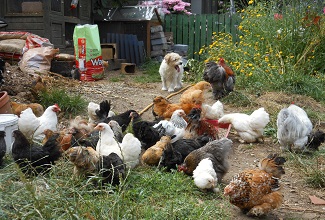
I read voraciously, adore playing Bridge, love listening to Radio 4, enjoy music from modern to classical, and keep a range of small animals as pets.
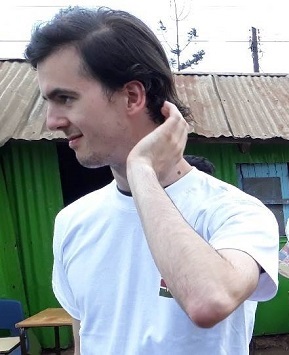
I earn my living by teaching privately, and when not working, I lead a charity called Porridge and Rice with a committee, all of whom are volunteers.
Ken Surridge

Porridge and Rice combats poverty in the Nairobi slums, home to some of the poorest people in the world, by enabling pupils at partner schools to obtain a sound education.


Ken's Many Musings
I write about things that interest or intrigue me. There is no theme or agenda just my thoughts and observations. I write for the simple pleasure of writing. If my writing brings pleasure to others, that is a bonus.
Do Not Go Gentle
25 August 2021
'Do Not Go Gentle Into That Good Night' is my favourite Dylan Thomas poem. I love the powerful verbs like burn, blaze and rave, that he uses to convey the strength of his pain and anger at the injustice of his father's undignified death from throat cancer and the way he urges his father to fight against his failing factulties like the loss of sight referred to as the 'dying of the light'.
Probably most effective for me is the opening phrase "Do not go gentle" which expresses beautifully the mix of love, anger, pleading and desperation the poet feels. He is reaching out to a man he loves that he knows is suffering wanting to express compassion and empathy but at the same time he wishes to rebuke him sternly and aggressively for yielding to the killer disease. It is the verbal equivalent of wanting to put your arms firmly around someone to hold them closely as an act of compassion but at the same time, feeling the need to scream, shout and hit out at them for being incredibly stupid. The poem wrestles with the real tension between mutually exclusive emotions.
Night, the end of the struggle, or literally death, brings relief from suffering, and is hence good, yet it is still night, dark and final. Thomas understands that from his father's perspective, walking towards the night must seem desirable while recognising that his father doing so, will be hurtful for him personally. Dylan's father, one of the 'wise men at their end', will'know dark is right' while Dylan feels cheated as the 'close of day' steals his father away from him.
'Do not go gentle in that good night' is an emotional poem that deals with the hurt and injustice of death. It is a very personal poem written by Dylan wrestling with his father's painful and untimely death. Dylan's incredible talent, turns a difficult subject into an exquisite piece of writing.
Do not go gentle into that good night,
Old age should burn and rave at close of day;
Rage, rage against the dying of the light.
Though wise men at their end know dark is right,
Because their words had forked no lightning they
Do not go gentle into that good night.
Good men, the last wave by, crying how bright
Their frail deeds might have danced in a green bay,
Rage, rage against the dying of the light.
Wild men who caught and sang the sun in flight,
And learn, too late, they grieved it on its way,
Do not go gentle into that good night.
Grave men, near death, who see with blinding sight
Blind eyes could blaze like meteors and be gay,
Rage, rage against the dying of the light.
And you, my father, there on the sad height,
Curse, bless, me now with your fierce tears, I pray.
Do not go gentle into that good night.
Rage, rage against the dying of the light.


Teenage Adoption
4 June 2021
According to UNICEF, there are nearly 153 million orphans worldwide. That is just under half the population of the US, about double the population of the UK, and almost ten times the population of the Netherlands. What is worse is that the figure is growing with an estimated 5,700 more children becoming orphans every day which is nearly double the number of deaths in the 9/11 tragedy. The figures are staggering.
Only a small proportion of orphans and children in care ever find permanent families, and the older the children are, the harder it is for them to find a home, in fact when they become teenagers, very small numbers are adopted. In poor countries, it is understandble that people would not want to take children in but in rich, western countries it should be possible to find more if not all orphans, families. In addition, I think that this should be a priority for governments, after all, a compassionate society, values and protects its children.
In the first instance, I suspect that most people are not aware of the scale of the problem and have thus never given the matter any thought. It is even possible that some people have thought about it and are worried that these children may come with challenges because of their troubled histories. This is not an unreasonable concern but it should not be allowed to be a barrier, and those that have adopted teenagers, have demonstrated that it is possible to build successful, happy families which include adopted children.
I am not an expert but from the research that I have done, children with at least one parent do better in life. They fare better at school, in building relationships, and in living within the law, in general, they lead more productive, happier lives. I would love to see a cost benefit analysis of children adopted versus those left to grow up in care. I would bet that the cost to society of investing in orphans to find them homes and ensure they succeed within their new families would be far less than the costs associated with the negative consequences of not doing so from mental health to crime, on both an individual and on a societal level.
I am not saying that all children which grow up in care or institutions will end up with mental health problems or become criminals, in fact, I have every confidence that many, probably most will not do so, despite the challenges of not having a family. What I am saying though is that that there is a cost both to the child and their society of growing up without a family in complex and intricate ways from long-term levels of happiness to social participation, and that the investment needed to find families, would be less than the cost of not doing so. I would go even further and propose that even if it is more expensive to find families for children than deal with the longterm negative fall out of children growing up with a family, the compassionate and moral thing to do is to find children homes, in essence, the happiness of the children should be placed first and money should not be a barrier even, if it turns out to be very expensive to place children in homes. It seems to me that a civilised and compassionate society would not place a price on the happiness and well-being of a child. No child asks to be born and certainly no child asks to be orphaned or put into care, in fact, we know that many children would rather stay with abusive and disfuntional families, than go into care. Given the pain of not having a family, it is in my view right that a society that cares about children will do everything in its power to ensure that every child has a place to call home and people to call family.
We are better human beings when we show compassion and understanding for the plight of other people especially children. Allowing children to grow up without at least one parent to love and cherish them, feels unjust and cruel. The compassionate thing to do to find families for children, families that will embrace them as their own, forever.
There is very little if any work being done to enable and encourage adoption. There are some courageous and special people who nonetheless adopt, especially teenagers, and they deserve support and respect. A small number of these people like the Crazy Pieces share their lives on social media. I realise that they do not share everything, and frankly, I don't think that it is reasonable to expect them to do so, as like the rest of us, they have every right to a private life, and it misses the point - they are providing children with homes, while others stand by and do nothing.
I think people willing to adopt, especially teenagers, deserve respect and support and I don't think they get enough of either.


Dating Amber
2 March 2021
Dating Amber is a sweet, thought-provoking film which while an enjoyable watch, is a stark reminder that it is still difficult for young LGBTQ people to come out publically. There are certainly some who come out confidently and are accepted by friends and family, but this does not appear to be the case for most gay youth, many of whom experience rejection, fear and distress.
Christianity has had a lasting influence on western civilisation, and while there are modern christians who accept LGBTQ youth, the legacy of christianity is a society which has judged same sex relationships as unnatural, abnormal and sinful, so much so that laws were enacted to imprison people for same sex relationships along with denying homosexual people equality and basic human rights. To this day, there are western countries which allow discrimination against gay people. For example, in many states in the US, it is still legal to fire someone for simply being gay, and popular fundamentalist preachers consistently blame gay people for natural disasters as 'god's anger'.
Even people who are in no way prejudiced, will assume teenagers are straight unless told otherwise. Heterosexual is the default and ask a teen boy "do you have a girl friend" is regarded by most as friendly small talk, ignoring the fact that for a young man who is not out, it could be frightening and hurtful. At school, the term 'gay' is used to convey anything unpleasant or awful, and teenagers are regularly bullied for being different.
While there is no doubt that being LGBTQ in first world countries, is more accepted with extensive protections and established rights, the stories and the suicide rates of LGBTQ youth, present considerable cause for concern. That there are young people being rejected by their families for being gay and young people choosing death rather than a life as gay, means that there is still a lot of work to be done to create a world free from bigotry.
The million-dollar question is how do we build a society where LGBTQ youth do not have to fear people knowing who they are attracted to, a world where LGBTQ children do not have to fear condemnation or rejection, a world that does not presume or judge but provides young people the freedom to express themselves safely, a world where people can just be who they are without feeling that there is anything wrong with them.
I look foward to such a world.


The poetry of Ogden Nash
5 January 2021
Poets who can be both humorous and insightful at the same time are rare. The American poet Ogden Nash (1902-71) was one such rarety, able to make the reader smile with what seems like trivial ideas and novel rhymes, but whose words on closer examination reveal profound thoughts.
Some poems like The Fly, were written for a younger audience, and consider the nature of things and their place in the natural world, while others such as A Word to Husbands, contemplate serious, sensitive subjects such as the role of honesty and communication in a marriage.
1. The Cow
The cow is of the bovine ilk;
One end is moo, the other, milk.
2. Reflections on Ice-Breaking
Candy
Is Dandy
But liquor
Is quicker.
3. The Duck
Behold the duck.
It does not cluck.
A cluck it lacks.
It quacks.
It is specially fond
Of a puddle or pond.
When it dines or sups,
It bottoms ups.
4. The Fly
God in his wisdom made the fly
And then forgot to tell us why.
5. The Octopus
Tell me, O Octopus, I begs,
Is those things arms, or is they legs?
I marvel at thee, Octopus
If I were thou, I'd call me Us.
6. The Pig
The pig, if I am not mistaken,
Supplies us sausage, ham and bacon,
Let others say his heart is big--
I call it stupid of the pig.
7. A Caution to Everybody
Consider the auk;
Becoming extinct because he forgot how to fly, and could only walk.
Consider man, who may well become extinct
Because he forgot how to walk and learned how to fly before he thinked.
8. A Word to Husbands
To keep your marriage brimming
With love in the loving cup,
Whenever you're wrong, admit it;
Whenever you're right, shut up.
9. Crossing the Border
Senescence begins
And middle age ends
The day your descendents
Outnumber your friends.


Farwell but do not "go gentle into that good night"
5 December 2020
I remember walking alone on a beach on a family camping holiday when I was 15 years old as clearly as if I were standing on the beach now. I can still smell the saltiness of the sea, hear the sand crunch underfoot, and feel the spray from the waves breaking on the rocks. It was nearly 45 years ago but the details of the family holiday are vivid and clear from the evenings playing cards in the tent until the gas lamp burned out and we were plunged into darkness to time spent on the beach either on my own enjoying the sights and sounds or splashing in the sea with my family. Life seemed full of promise with an endless number of years ahead. I had no thoughts of death, mine or that of any member of my family.
My father died on 26 November 2020. He was 89 years old and not in the best of health, but it still came as a big shock. and it hit me harder than I expected. If you had asked me before he died, I would have surmised that I would face his death with some emotion but rationally. That is not what happened.
I have cried every day since he died sometimes deep sobs and sometimes silent tears. Somedays I have cried multiple times and sometimes just once. At times, my tears were triggered by a memory and at times they arose spontaneously, seemingly for no apparent reason. I have contemplated my response looking for explanation but the truth is I do not understand it. I do not know whether the unexpected loss, the finality of death, or just the fact that we will never speak again has caused so strong a response. What I do know is that it hurts more and goes deeper than I expected.
At 89 years old, he lived a long life, much longer than many people from his generation, but even though I know this intellectually, it still feels too soon. I suspect that had he lived another 10 years, my feelings would be no different when he died. It seems to me that loss hurts no matter how old the person.
In addition, my father's death has taught me that grief is more expansive than I thought. It is a varied mixture of feelings with elements waining, swelling, and combining. Grief includes hurt, anger, sadness, pain, regret, numbness, missing, confusion, reflection, introspection, denial, longing, disbelief, wishing, hurt, anguish, angst, vexation, woe, despondency, and more. Grief is not just sadness - it is far more.
Even though is just over a week now that he died, slowly grief is making room for memories, happy memories, nostaligic memories, funny memories, even mundane memories, all of which are moments to savour and relive. Memories live forever and are a legacy of a life lived. Memories are a gift to the living.
I am sure that I am not done with tears, but with time, I believe that the memories will assuage the grief. The memories are his legacy, a library in my mind that I can peruse and appreciate at my leisure.
While in one respect, I have had to say farewell, in another I know that he will "not go gentle into that good night" as the memories will "rage, rage against the dying of the light".


Justified
28 November 2020
I have never liked Westerns so was really surprised to find myself gripped by the American series Justified which is part Western and part crime drama.
I particularly liked the characters because they were a complex mixture of good and bad. Unlike the traditional goodies and badies of Westerns, it was possible to like and dislike each at different times, and I grew fond of the central criminal Boyd who despite his heinous crimes demonstrated love, loyalty, understanding, and integrity at points. I found it impossible to hate him and even found myself feeling sorry for him at times. I found myself feeling the same for the maverick hero US Marshall Raylan with his troubled personal relationships and obsession with doing what he believed to be wrong no matter what rules he broke to get there. What I thought was particularly clever, was the relationship between the two which at times was friendship as each showed consideration for the other. There were characters that were predictable and simplistic but they felt more like props than people the audience was supposed to engage with.
The plot kept me interested moving quickly from issue to event and linking them with the real trials faced by poor communities in forgotten areas of states like Kentucky. There is an admirable determination to survive in places where life offers few legal choices and people break the law to survive. The series does not justify violence and breaking the law but it does portray both in a way that makes it possible for the viewer to understand how people could find themselves in places where both look like good choices.
I do not think that the series is meant to be a deep investigation of the rights and wrongs of crime or the social issues that drive people to them, but it deals with them in an intelligent and sympathetic manner through imperfect characters, all the time maintaining engaging plot lines. Watch a few episodes and judge for yourself. I suspect you might like the series.


The Farm at 64
18 October 2020
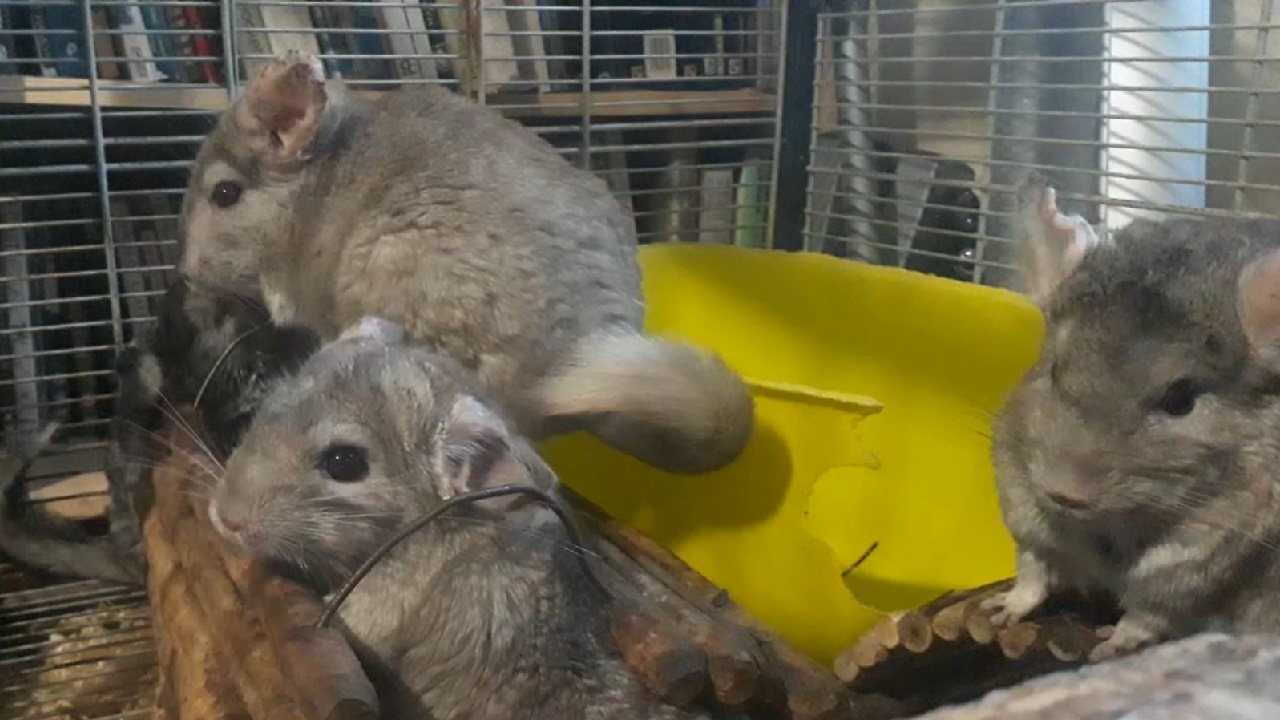
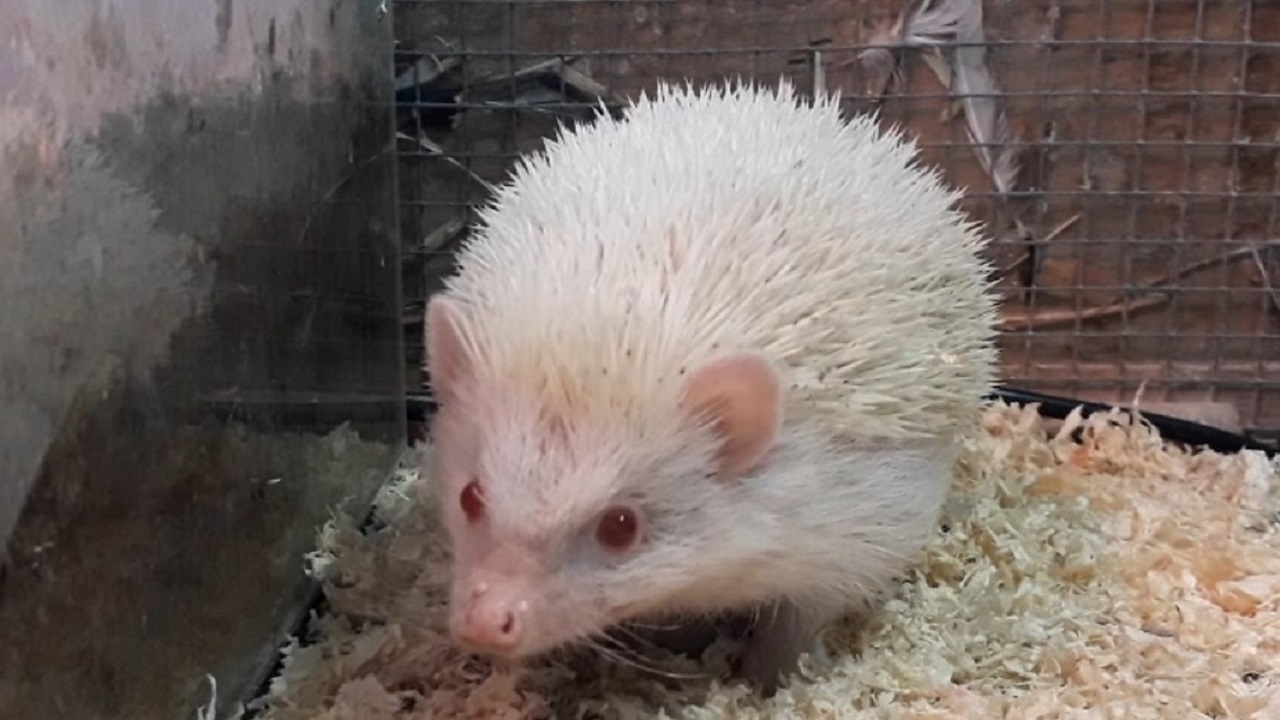
I don't have a farm, in fact, I live in a London suburb in a typical semi-detached house. What I do have is a lot of pets that my children chose to refer to as 'The Farm' growing up. My house number is 64, and le voila, we have The Farm at 64.
I recently started a YouTube channel for The Farm at 64 to raise money for the charity Porridge and Rice. The aim is to monetise the channel and use the income for the work of the charity. Hopefully, the day is not far off. Please considering watching and subscribing.




Einstein, the activist
29 September 2020
I suspect that most people know that Einstein was a scientist, many could recognise his picture, and some may even know that his general theory of relativity brought him fame as a scientist, but I would conjecture that few people know that he was an ardent peace and civil rights activisit for his whole life.
At the age of 16, long before anyone knew his name, Einstein renounced his citizenship because of German militarism and aggression, preferring to be stateless. This was not a one-off, but the beginning of a life fighting for social justice using his fame to gain access to influential people and important platforms to promote peace and civil rights. At times, he put his own life at risk, and he never allowed potential consequences to his reputation to stop him advocating loudly for social justice despite many friends urging him to do so. He was a man of principle, determined, outspoken and courageous.
As soon as he had the limelight, Einstein began speaking out. In interviews, he advocated for an end to militarism and mandatory military service in Germany. His identity politics aroused the ire of many people in Germany, including those who were motivated by nationalism and anti-Semitism. Nobel Prize-winner Philipp Lenard, who eventually became a Nazi, fought hard behind the scenes to make sure Einstein wouldn't win a Nobel himself. Ultimately the Nobel committee decided not to award any physics prize in 1921, partly under anti-Semitic pressures from Lenard and others. (They honored Einstein the following year, giving him the delayed 1921 prize alongside his friend Niels Bohr, who got the 1922 prize.)
In 1929, a German publisher distributed a book titled One Hundred Authors Against Einstein. Although it was primarily a compilation of essays seeking to disprove the theory of relativity, the book also included some openly anti-Semitic pieces.
But it wasn't just anti-Semitic scientists who criticized Einstein. Fellow scientists, including Einstein's friends, expressed disapproval of his love of the limelight. "I urge you as strongly as I can not to throw one more word on this subject to that voracious beast, the public," wrote Paul Ehrenfest, Einstein's close friend and fellow physicist, in 1920. Max and Hedwig Born, two other friends, were even more adamant, urging him to stay out of the public eye: "In these matters you are a little child. We all love you, and you must obey judicious people," Max wrote to him the same year.
As a target of anti-Semitism, Einstein was well aware of the impact of discrimination. Speaking out against the Nazis, Einstein was forced to flee for his life, first to Belgium, then the UK, and finally the US where he spent the rest of his life. When Einstein settled in the US, it was strictly segregated, with separate schools and movie theatres for blacks and whites. In addition, Princeton University where he worked, wouldn't admit black students.
"Being a Jew myself, perhaps I can understand and empathize with how black people feel as victims of discrimination," he said in an interview with family friend Peter Bucky. While his political opinions made him a controversial figure, they also got traction, because his words resonated more than most.
Einstein's first aggressive criticism of American racism came in 1931, before Hitler's rise to power. That year, he joined writer Theodore Dreiser's committee to protest the injustice of the "Scottsboro Boys" trial.
In the trial, now one of the most iconic instances of a miscarriage of justice in America, nine African-American teenagers were falsely accused of raping a white woman. Eight were convicted and sentenced to death without evidence or adequate legal defense, and under pressure from armed white mobs. The case was then successfully appealed to the U.S. Supreme Court, an effort led by both the National Association for the Advancement of Colored People (NAACP) and the Communist Party. As a result, many white Americans took the wrong side of the case not only out of racism, but out of anti-Communist sentiment.
Robert Millikan, American physicist and Nobel Prize-winner, criticized Einstein for associating himself with left-wing elements in the Scottsboro case, calling his politics "naive." (Their disagreement didn't stop Millikan from trying to recruit Einstein for Caltech.) Other Americans were less polite: Henry Ford of car manufacturing fame republished libelous essays from Germany against Einstein.
Shortly before moving to America, Einstein backed a campaign to defend the Scottsboro Boys, nine Alabama teenagers who were falsely accused of rape in 1931.
When Princeton's Nassau Inn refused to rent a room to contralto opera star Marian Anderson because of her skin color, Einstein invited the singer home as his guest. Their friendship lasted from 1937 until his death in 1955, and Anderson stayed with the Einsteins whenever she visited Princeton.
In 1946, Einstein gave a rare speech at Lincoln University in Pennsylvania, a historically black university, where he also accepted an honorary degree. The appearance was significant because Einstein made a habit of turning down all requests to speak at universities. During his speech, he called racism "a disease of white people."
Einstein was a friend and supporter of African-American actor and singer Paul Robeson, who was blacklisted because of his civil rights work. The pair worked together in 1946 on an anti-lynching petition campaign. In 1952, when Robeson's career had bottomed out because of the blacklisting, Einstein invited Robeson to Princeton as a rebuke to the performer's public castigation.
Also in 1931, Einstein accepted an invitation from the great African-American sociologist and NAACP co-founder W.E.B. Du Bois to submit a piece to his magazine The Crisis. Einstein took the opportunity to applaud civil rights efforts, but also to encourage African-Americans not to let racists drag down their self-worth. "This ... more important aspect of the evil can be met through closer union and conscious educational enlightenment among the minority," he wrote, "and so emancipation of the soul of the minority can be attained."
For decades, Einstein offered public encouragement to the National Association for the Advancement of Colored People (NAACP) and its founder, W. E. B. Du Bois. And in 1951, when the federal government indicted the 83-year-old Du Bois as a "foreign agent," Einstein offered to appear as a character witness during the trial. The potential publicity convinced the judge to drop the case.
In January 1946, Einstein published an essay, "The Negro Question," in Pageant magazine in which he called racism America's "worst disease." Here is an excerpt from that essay.
"There is, however, a somber point in the social outlook of Americans. Their sense of equality and human dignity is mainly limited to men of white skins. Even among these there are prejudices of which I as a Jew am clearly conscious; but they are unimportant in comparison with the attitude of the "Whites" toward their fellow-citizens of darker complexion, particularly toward Negroes. The more I feel an American, the more this situation pains me. I can escape the feeling of complicity in it only by speaking out. Your ancestors dragged these black people from their homes by force; and in the white man's quest for wealth and an easy life they have been ruthlessly suppressed and exploited, degraded into slavery. The modern prejudice against Negroes is the result of the desire to maintain this unworthy condition."
Yet whatever problems America had with inequality and racism at this time, Europe had problems of its own. In 1933, a well-timed job offer in the states led Einstein to become a citizen of the nation he loved enough to criticize.
Einstein and his wife Elsa left Germany in December 1932. Armed with 30 pieces of luggage, the pair were ostensibly taking a three-month trip to America. But they knew what was coming: In January 1933, Adolf Hitler and the Nazi party took full control of the German government.
While the Einsteins were in California, the Nazi government passed a law banning Jews from teaching in universities. "It is not science that must be restricted, but rather the scientific investigators and teachers," wrote one Nazi official. Only "men who have pledged their entire personality to the nation, to the racial conception of the world ... will teach and carry on research at the German universities."
In their absence, the police raided the Einsteins' apartment and their vacation cottage under the pretense of looking for weapons. When they found nothing, they confiscated the property and put a $5,000 bounty on the physicist's head, distributing his picture with the caption "not yet hanged." By the spring of 1933, the most famous scientist in the world had become a refugee.
Einstein was a more fortunate refugee than most. By that time he was already a Nobel Prize winner and media celebrity, recognizable around the world. That fame made him a high-profile enemy for the new Nazi government in Germany, but it also guaranteed him safe places to go. Ultimately he ended up in America at the Institute for Advanced Study in Princeton, New Jersey, where he would spend the rest of his life.
Einstein saw racism as a fundamental stumbling block to freedom. In both his science and his politics, Einstein believed in the need for individual liberty: the ability to follow ideas and life paths without fear of oppression. And he knew from his experiences as a Jewish scientist in Germany how easily that freedom could be destroyed in the name of nationalism and patriotism. In a 1946 commencement speech at Lincoln University, the oldest black college in the U.S., Einstein decried American racism in no uncertain terms.
"There is separation of colored people from white people in the United States," said the renowned physicist, using the common term in the day. "That separation is not a disease of colored people. It is a disease of white people. I do not intend to be quiet about it."
After settling down in America, Einstein continued to publicly denounce American racism. In a 1946 address to the National Urban League Convention, he even invoked the Founding Fathers in his critique. "It must be pointed out time and again that the exclusion of a large part of the colored population from active civil rights by the common practices is a slap in the face of the Constitution of the nation," he said in the address.
The irony of ending in Princeton, one of the most racially segregated towns in the northern U.S., was not lost on Einstein. While no town was free of racism, Princeton had segregated schools and churches, generally following the Jim Crow model in practice if not by law. The University didn't admit any black students until 1942, and turned a blind eye when its students' terrorized black neighborhoods in town, tearing porches off houses to fuel the annual bonfire.
Einstein loved to walk when he was thinking, and frequently wandered through Princeton's black neighborhoods, where he met many of the residents. He was known for handing out candy to children - most of whom were unaware he was world-famous - and sitting on front porches to talk with their parents and grandparents, little-known facts reported in the book Einstein on Race and Racism by Fred Jerome and Rodger Taylor.
Black Princeton also gave him an entrance into the civil rights movement. He joined the NAACP and the American Crusade Against Lynching (ACAL), an organization founded by actor-singer-activist Paul Robeson. At Robeson's invitation, Einstein served as co-chair of ACAL, a position he used to lobby President Harry S. Truman.
He made friends with Robeson, who had grown up in Princeton, and found common cause with him on a wide variety of issues. As Jerome and Taylor note, "almost every civil rights group Einstein endorsed after 1946 ... had Robeson in the leadership." In particular, Einstein joined Robeson and other civil rights leaders in calling for national anti-lynching legislation.
For his anti-racist activism, he was placed under FBI surveillance by J. Edgar Hoover. While Hoover's FBI refused to investigate the Ku Klux Klan and other white terrorist organizations, there wasn't a civil rights group or leader they didn't target. By the time of his death, the FBI had amassed 1,427 pages of documents on Einstein, without ever demonstrating criminal wrongdoing on his part.
But to a large degree, his celebrity protected him against enemies like Hoover and more garden-variety American anti-Semites. Hoover knew better than to publicly target Einstein. Einstein used his profile and privilege, volunteering to serve as character witness in a trumped-up trial of W.E.B. Du Bois. His influence had the desired effect: When the judge heard Einstein would be involved, he dismissed the case.
Einstein's fame afforded him a larger platform than most, and protection from the threats that faced black civil rights leaders. What is remarkable is that, throughout his career, he continued to throw his full weight behind what he saw as a larger moral imperative. "[W]e have this further duty," he said to an audience in the Royal Albert Hall in England in 1933, "the care for what is eternal and highest amongst our possessions, that which gives to life its import and which we wish to hand on to our children purer and richer than we received it from our forebears."


Orphans in Ukraine
24 August 2020
Ukraine is not only one of the two poorest countries in Europe, the other being Moldova, but a very poor country in global terms.
A Global Wealth Report by Credit Suisse placed Ukraine at 123 out of 140 countries in terms of its citizen's median personal wealth. The same study shows that the median personal wealth equivalent of Ukrainians is $1,563 per adult resident, the same as nearby Belarus but less than Bangladesh ($2,322), Kenya ($2,306) and Nepal ($2,054). Just behind Ukraine in terms of the wealth of their people are Zambia ($1,197) and Mali ($1,094). This is compared to Australia ($191,450) which is slightly ahead of Switzerland ($183,340) and can claim the title of having the world's wealthiest citizens.
As part of the USSR, Ukraine had the second-largest economy in the Soviet Union but its transition to a market economy has been beset by numerous issues resulting in a country where a very small number of people have are obscenely rich while the vast majority of the population are desperately poor. Ukraine has the basis for a strong European economy with rich farmlands, a well-developed industrial base, highly trained labour, and a good education-system but issues such as government corruption and Russian aggression have prevented it from developing one. Unfortunately, there appears to be no end in sight to the factors that are causing the dire poverty in the Ukraine.
While adults suffer as a result of widespread poverty, children suffer considerably more as the adults and social services that are meant to care for them cannot provide them with the support and nuture that they need. What often makes it worse, is that adults in dire poverty frequently seek harmful ways to ameliorate their distress and pain like alcohol and drugs, making them even less able to nuture their children and exposing these children to dangerous and harmful experiences. Children that do not receive the care, love, and nuturing they need frequently grow up into dysfunctional adults, emotionally and mentally scarred, that lead unproductive and destructive lives.
There are around 100 000 children in orphanages in Ukraine, in fact, based on official data, an estimated 250 children enter the orphanage system daily, with many more children living on the streets or in inadequate situations with adults unable to provide or care for these children. In addition, within two years of leaving the orphanage, 80% of orphan graduates in Ukraine are involved in drugs, crime, prostitution, in jail, or commit suicide. It is a tragedy taking place in Europe, one of the richest most-privileged parts of the world. Lives that could be productive and happy, are destroyed daily.
In Ukraine, orphanges are not only for children whose parents are dead, but also children whose parents are unable to provide for their children for reasons such as drug or alcohol prediction, abuse, dire poverty, and incarceration. Orphans with living parents are referred to as social orphans. Regardless of whether they have parents or not, children in orphanages have deep emotional and social scars from abandonment or abuse.
Orphanges in Ukraine are usually boarding schools with the children living and going to school in the same building with the same people every day. They do not get the chance to socialise with children and people who are not in orphans. While living in a boarding school is arguability better than being on the streets or living with parents unable to care for their children, growing up in an institution is not ideal as it does not provide many opportunities for children to develop the social and interpersonal skills needed to function effectively in society.
It is rare for children in Ukrainian orphanages to have the opportunity to complete their schooling as a lack of funds means that they are forced to "graduate" from their orphanages at the end of grade 9, around the age of 15-16, unable to complete the last 2 years of school. They are simply forced to leave the orphanage because there is not enough state funding to keep them through grades 10 and 11.
Making a bad situation worse, children that have grown up in an orphanage, are regarded with suspicion by the rest of society. The are perceived as untrustworthy and deliquent so landlords are reluctant to rent to them and employers are hesitant to hire them. They are severely disadvantaged by social attitudes by a society which regards them as untrustworthy and deliquent.
In essence, a lack of funds means that orphanages are unable to prepare children for independent life and when they are forced to leave the orphanages, society will not accept them sometimes treating them with outright hostility. with suspicion and sometimes outright hositility.
Children from orphanages are usually left with no good choices when they complete year 9. The most common options are to return to living with addicated, poverty-stricken, or dysfunctional family members, asking for a place to sleep with equally disadvantaged friends, or moving onto the streets to live in places like drains, benches or in the doorways. Even the few children from orphanges that find places in trade schools, struggle without a permanent home or the funds to buy necessities like food and clothing.
It is thus no surprise that a staggering number of orphan graduates fall into crime, prostitution or alcoholism after they leave the orphanage. Figures show that at least 60 to 70% of Ukrainian orphan graduates become involved in prostitution or organized crime, 20% end up in prison within 2 years, and 10% commit or attempt suicide. Others embrace alcoholism and produce a new generation for the orphanage. Less than one percent make it to a university or higher education. Tragically, the orphanges are failing to prepare children adequately for a successful, independent, adult life, and a lack of funds means that thousands of Ukrainian boys and girls are destined to live difficult, damaged lives.


The Real SpongeBob SquarePants
21 July 2020
In 2010, researchers at San Francisco State University discovered a new species of mushroom under a tree in the Lambir Hills in the humid forests of Sarawak on Borneo. According to the researchers, the newly discovered orange fungus was a dead ringer for the cartoon character SpongeBob SquarePants, so it was formally described and name spongiforma squarepantsii in 2011.
Dr Desjardin mentioned that the editors of Mycologia initially rejected the cartoon name as "too frivolous." "But we insisted that although the science might be their business, we could name it whatever we liked," said Dr Desjardin. "We need a little frivolity in this stodgy old science we love."
The Spongebob Squarepants mushroom is bright orange and smells "vaguely fruity or strongly musty," according to Desjardin and colleagues in the journal Mycologia. "It's just like a sponge with these big hollow holes," said Dennis Desjardin, a professor of ecology and evolution at the San Francisco State University. "When it's wet and moist and fresh, you can wring water out of it and it will spring back to its original size. Most mushrooms don't do that."
The Spongebob Squarepants mushroom is always found beneath tall dipterocarp trees in the Lambir Hills National Park in Borneo. This National Park is a tropical rainforest that receives around 3,000 millimetres of rain every year, and has no seasons. The daily temperature ranges from 24 to 32 ° Celsius.
Researchers estimate that there are somewhere between 1.5 and 3 million fungal species in the world, but only five percent have been formally described. In addition, the new mushroom is only one of two species in the genus Spongiforma. The other one is found in central Thailand, but differs in both colour and odour.
The researchers said that Spongiforma's ancestors had the characteristic cap and stem of other mushrooms, but that these features had been lost over time.


Defending against the weak NT
20 December 2019
The main value of opening 1NT opening with a balanced 12-14 HCP is the pre-emptive nature of the bid. As with all pre-emptive bids, there is a risk that partner holds little or nothing, but the hope is that removing all the 1 level bidding space from the opposition makes any penalities incurred worthwhile. It is because it removes 1 level bids that 1 NT is difficult to defend against and various conventions like Landy, multi-Landy, and Asptro have developed to communicate information efficiently without bidding too high.
The most basic defences against to a weak NT opening are
- 'double' to show 15+ HCP
- 2♣ for Landy promising both majors
- 2 ♦/ ♥/ ♠ a natural overcall to to show 5 of the suit
- 3♣ a natural overcall in clubs
The points required for any of these bids can be reduced by 3 HCP by the player sitting in the fourth seat (the protective position) if both partner and the RHO have passed the opening bid.
Double
Double over 1NT is for penalities. Over the double
A bid of 2♦, 2♥, or 2♠
If game in 3NT or partner's suit is unlikely then pass. The only exception is if you have a singleton or void in partner's suit, then bid your best suit at the appropriate level.
Landy
Landy recognises the importance of majors and is a bid of 2♣ over 1NT.
If using HCP, Landy promises
- 5-5 or 5-4 in the majors (only 4-4 in exceptional cases)
- most of the HCP are in the majors
- preferably at least two honours in each major suit
- with 5-5, 10 points if vulnerable or 7 if not
- with 5-4, 12 points if vulnerable, or 10 if not
- Landy with 4-4 is dangerous because it can lead to a contract with a 4-2 fit
- if vulnerable, 6 losers (so, a good opening hand, compared with the normal 7-loser opening hand)
- 7 losers if not vulnerable
After 2♣
- without points for game, respond with your best major
- without points for game and no preference, bid 2♦ for partner to bid their preferred major
2♦ is a negative relay - with good points, bid 2NT for partner
2NT is a positive relay
After 2NT
- bid 3♣ with a minimum overcall and no strong preference for either major
- bid 3♦ with a maximum overcall and no strong preference for either major
- bid 3 ♥/ ♠ with a minimum and a 5 card suit
- bid 4♣ with a maximum and a preference for ♥
- bid 4♦ with a maximum and a preference for ♠


A fine-tuned universe
12 December 2019
The fine-tuning argument is a popular argument that apologists present as evidence for a god which asserts that the universe with its laws and initial conditions, only permits life because these very laws and conditions are set up precisely and exactly to support life, and that small changes in them would make life impossible. The proposed conclusion is that this seemingly exquisite fine-tuning of the universe could not happen by chance and is thus evidence for a creator which theists then assert is a god.
This argument is a variation on the argument from design that uses cosmology rather than biology, with different versions adding the argument from incredulity, god of the gaps, and frequently, an attempt to shift the burden of proof.
The universe is larger than necessary
The universe is largely hostile to life
God created details that are unnecessary for life
The universe is largely hostile to life with vast swathes in which life-as-we-know-it cannot survive, places where gravitational forces would crush known living organisms and places where temperatures are too extreme for the formation of stable chemical bonds. With most of the observable universe uninhabitable to life, if the universe were designed for life, it is a shockingly inefficient design so much so that as Stephen Hawkings stated, if the universe were designed for anything, it was for the creation of black holes rather than life-as-we-know-it.
The universe is larger than necessary. Considering the diameter of the earth, the milky way, and the observable universe -
- earth's diameter is 12,742km
- the milky way's diameter is 9.46x10¹⁷
- the observable universe's diameter is 8.80x10²³
The earth's diameter is 0.000 000 000 000 013 5 % of the diameter of the milky way with 99.999 999 999 999 986 5 % not for life-as-we-know-it.
The earth's diameter is 0.000 000 000 000 000 000 014 5 % of the diameter of the observable universe so 99.999 999 999 999 999 999 987 5% of the observable universe is not for life-as-we-know-it.
The earth is WAY BEYOND MINISCULE compared to the Milky Way and the observable universe. If the purpose of the observable universe is to provide a place for humans to live, it is an understatement to say that it is a ridiculously wasteful design, in fact, the earth is such a small fraction of the observable universe, that frankly it is more reasonable to assume humans are entirely irrelevant to it, or that the universe was created for something like the existence of black holes and galaxies. Not even the whole of the solar system would have be necessary to support humans beings let alone the rest of the observable universe - the universe is ridiculously larger than necessary.
Assumes life "as we know it" is the only type of life
The proposition is that even minute variations in the values of the constants of the universe would result in a radically different universe unsuitable for life - this assumes that life-as-we-know-it is the only type of life. It may well be that an alternative universe may not support life-as-we-know-it, but this does not mean that an alternative universe would not support a different form of life to life-as-we-know-it. Humans simply do not have the knowledge to be able to test what forms of life may or may not be possible in universes different to the known universe. The fine-tuning arguments requires its proponent to show that no other forms of life are possible, something for which there is absolutely no evidence.
Even on the earth as we know it, scientists have had to be revise their understanding of the conditions under which life can survive more than once as more and more extremophiles have been discovered - bacteria have been found living in ice and living in near-boiling water around 80 °C, fish have been found living near the bottom of the deepest seas at pressures that would crush humans, and snails have been found living in saturated solutions of salt. Extremophiles are so named because of the extreme conditions the live in, conditions that many biologists once thought could not support life.
Humans only know of one universe that exists under one set of conditions which cannot be altered to test what would happen under different conditions. It simply cannot be said that no other universes could exist with conditions that would support one or more forms of life. With current knowledge, all that can be said is that life specifically as it is known on the earth has evolved to live in the one observable universe under the conditions of the one world that contains humans.
Natural processes are not random
False dichotomy, argument from ignorance
The notion that the universe with its parameters came about either by chance or through the actions of an intelligent designer is a false dichotomy resulting from a common error made by apologists, namely confusing natural processess with random processes. There are more than two possible options - two other possibilities are that some unknown natural process or processes caused the universe to be as it is, or that the universe could not be other than it is. If the properties of the universe were determined by natural processes, it is inappropriate to apply probability because chance does not enter into it. A common error made by apologists is to confuse natural processes with random processes, and then appeal to incredulity misrepreseting it as probability. Natural processes are not random. Natural processes proceed by necessity.
Invalid use of probability
Parameters are not necessarily independent
Some parameters don't need fine tuning
The fine-tuning claim pretends to be able to evaluate the probability of the observable universe existing as opposed to some other universe. Humans would need a comprehensive list of parameters with all their possible values as well as relationships between them to evaluate which universes may be possible and the properties of each. At present, this knowledge does not exist, in particular, relationships between identified parameters may yet emerge that the fine-tuning argument assumes to be independent. For example, one cannot claim that the gravitational constant and the speed of expansion of the universe are individually tuned, since they are clearly related. The electromagnetic force is mediated by massless photons which travel at the speed of light, so therefore the strength of this force is likely related to the speed of light. Similar relationships may yet emerge between other constants. In order for the probability argument to be valid, the fundamental constants under consideration have to be independent.
For the reasons explained, it is simply not possible to even begin to evaluate probabilities as probability involves a mathematical calculation based on the number of possible outcomes, known relationships, and specific variables. The likelihood claim is no more than trying to dress up an appeal to incredulity in mathematical clothing. We do not have the knowledge to evaluate the probability of any of the many options proposed including as Matt Dillahunty likes to put it "universe creating pixies".
Humans know only one universe and have no way of knowing how many other universes might be possible. To avoid an argument from ignorance, one must be able to list and rule out all other possible universes - the failure to do so in an argument from ignorance.
Stephen Hawking summed up the problem when he said that "... the 'fine tuning' of the universe's physical constants ... would be a great proof if it wasn't exactly the same thing we'd see if a god didn't exist."
Apologists liken the fine-tuning argument to surviving a firing squad execution when all the shooters "missed". They argue that it is more likely that the firing squad never intended to kill rather than they all have poor aim. The analogy fails for two reasons. Firstly, humans understand and can test the hitting and missing of targets so can calculate the probabilities of all members of a firing squad missing - by contrast humans have no knowledge of universe creation or more than one universe so cannot assess the probability of a natural basis for the existence of the universe versus a supernatural one. In this respect, all that can be said is that, there is vast amounts of evidence for the existence of natural processes and absolutely zero evidence for the supernatural existing, let alone acting as a cause. Secondly, even if the probability of the firing squad missing by accident is incredibly small IT IS NOT ZERO which makes it a real possibility. The probability of a person winning the lottery is incredibly small, yet it happens regularly without fail. It is fallacious to equate a small probability with the notion that something would or did not happen.
The fine-tuning argument says nothing about who or what set up the laws and parameters of the known universe, or that his entity (or entities) is even supernatural. The argument supports no particular religion or theology. There is simply no reason to assume that some god or gods created the universe it versus a giant invisible all-powerful penguin with magic powers. The leap to 'it must be a god or gods', let alone 'my particular god' is irrational. The fine tuning argument therefore has a weak conclusion.
The fine tuning says very little about the attributes of the intelligent designer for which it argues. It is not necessary for the creator to be loving, in fact, it could be totally uninterested in humans, even dislike them. It is not necessary for the creator to be eternal - it may may have expired as a result of the creation or could have expired at some point in tiome of some cause unknown to us. Similarly, there is no reason for the creator to be omniscient or omnipotent - it may just be powerful enough to create a universe and not much else. Using the conclusion "the intelligent designer exists" to support the premise "an intelligent designer is omnipotent, all loving, etc" is affirming the consequent, a formal fallacy. Poor explanation God supposedly is an explanation for fine tuning. However, God is a bigger mystery than the one we seek to explain. A reasonable explanation would depend on known entities, rather than using one mystery to explain another.
Douglas Adams coined the term 'puddle theory' to satirize the fine-tuning argument. In the words of Adams in his book The Salmon of Doubt "Imagine a puddle waking up one morning and thinking, 'This is an interesting world I find myself in, an interesting hole I find myself in, fits me rather neatly, doesn't it? In fact, it fits me staggeringly well, must have been made to have me in it!'" The point Adams is making is that the universe was not setup to enable life to survive, but that life has formed to fit the universe that exists.


Bidding Conventions
11 November 2019
The conventions described are for the Acol system of Bridge. They are not authorative but based simply of what I understand and play - other players may have their own version of the listed conventions.
1. Roman Key Card Blackwood
Roman Key Card Blackwood (RKCB) is a refinement of standard Blackwood, making it possible to ask about aces and the king of trumps with a single bid. It also enables the presence of the trump queen to be investigated. In standard Blackwood, the holding of the King cannot be determined until the 6 level and the holding of the Queen, cannot ever be determined. RKCB is a useful tool when exploring the possibility of bidding a slam.
In RKCB, the 4 Aces AND the King of Trumps are referred to as the "five Aces". The trump suit must be agreed before using Roman Key Card Blackwood, a bid of 4NT.
Examples of RKCB are:
- 1♠ - 3♠ - 4NT is RKCB with spades as trumps
- 1♣ - 1♦ - 3♦ - 4NT is RKCB with diamonds as trumps
- 1NT - 2♣ (Stayman) - 2♥ - 4NT is RKCB with hearts as trumps
- 1♠ - 4♦ (Splinter) - 4NT is RKCB with spades as trumps
- 1♥ - 2NT (Jacoby) - 3♥ - 4NT is RKCB with hearts as trumps
- 1NT - 2♥ (Transfer to Spades) - 2♠ - 4NT is RKCB with spades as trumps
To progress to a slam, a partnership should hold at least 4 out of the 5 key-cards (unless there are useful voids). Even then, a slam should be avoided if it can be determined that the partnership is missing one keycard and the trump queen.
1.1 Responses to 4NT
There are two systems in RKCB known as 0314 and 1403. Most players prefer 1403 because it appears to keep the bidding lower. Playing the preferred 1403, the responses to 4NT RKCB are -
- 5♣ shows 1 or 4 of the "five aces";
- 5♦ shows 0 or 3 of the "five aces";
- 5♥ shows two without the queen of trumps;
- 5♠ shows two with the queen of trumps
Playing the less popular 0314, the responses to 4NT RKCB are -
- 5♣ shows 0 or 3 of the "five aces";
- 5♦ shows 1 or 4 of the "five aces";
- 5♥ shows two without the queen of trumps;
- 5♠ shows two with the queen of trumps
It is most likely that RKCB is used when a strong hand interested in slam is asking a weaker hand about key cards. To keep bidding as low as possible it is thus better for 5♣ to signal 1 king as 3 is highly unlikely. This way, 5♦ to used to ask for the queen of trumps. This lower step is especially important when hearts is the agreed suit. Now the queen-ask can be made beneath the five level of the agreed suit.
In both systems, the answers may be ambiguous but previous bidding or the 4NT bidder's holding itself, usually makes the most probable alternative clear.
If responder holds a void, RKCB can be extended to show the void along with the number of key cards. The reponses to 4NT are
- 5NT shows an even number of key cards and a void
- 6♣ shows an odd number of key cards and
- a club void if clubs aren't trumps, or
- a void in any other suit if clubs are trumps
- 6♦ shows an odd number of key cards and
- a diamond void if hearts or spades are trumps, or
- a void in hearts or spades, if diamonds are trumps
- 6♥ shows an odd number of key cards and
- a heart void if spades are trumps, or
- a spade void if hearts are trumps
1.2 Asking for Kings 5NT
Bidding 5NT asks partner for kings and is used to explore the possibility of a grand slam. It should only be used if the partnership holds all 5 key cards and the queen of trumps. There are two ways of responding.
Option 1: partner bids his cheapest (non-trump) king.
Option 2: partner uses stand Blackwood to show the number of kings.
- 6♣ shows 0 kings
- 6♦ shows 1 king
- 6♥ shows 2 kings
- 6♠ shows 3 kings
An example auction playing RKCB with the 5NT "cheapest" king-ask
1♥ -
3♥ -
4NT -
5♠ -
5NT -
6♦ -
6♥
- 3♥ confirms hearts as trumps
- 4NT is RKCB
- 5♠ shows 2 key cards with the Q♥
- 5NT ask for partner's cheapest king
- 6♦ shows the K♦ and denies the K♣
- 6♥ signs off in a small slam because of the missing K♣
1.3 Asking for the Queen of trumps
Over the 5♣ and 5♦ responses, the 4NT bidder can ask for the queen of trumps by bidding the cheapest non-trump suit to ask this question
Responses to the Queen Ask are
- Bidding 5 of the the trump suit shows no trump queen
- Bidding 6 of the the trump suit shows the trump queen
- 5NT shows the trump queen without any side-suit kings
- Bidding any non-trump suit shows the trump queen AND the king of that suit
An example auction playing RKCB 1430 with a queen-ask
1♠ -
2♣ -
3♦ -
3♠ -
4NT -
5♣ -
5♦ -
5♠
- 3♠ confirms spades as trumps
- 4NT is RKCB
- 5♣ shows 1 key card
- 5♦ asks for the Q♠
- 5♠ denies holding the Q♠
1.4 An example
Consider the following bidding sequence
1♠ -
2♥ -
4♥ -
4NT -
5♣ -
5♦ -
6♥
- 4♥ confirms hearts as trumps
- 4NT is RKCB
- 5♣ shows 0 or 3 key cards
- 5♦ asks for the queen of trumps
- 6♥ promises the queen of hearts
2. Splinter Bids
A splinter bid is a double-jump in a new suit and shows
- a singleton or void in the new suit
- agreement that the last suit bid is trumps (at least 4 card trump support)
- game going values
- slam interest
In addition
- a splinter bid can be used after the initial opening bid (12+ points) or the responding bid (15+ points)
- a splinter bid by responder shows at least 12 points
- a splinter bid by opener shows at least 15 points
- a single jump for a splinter is sufficient if at the four level
- a splinter bid takes preference over a Jacoby 2NT (hence a Jacoby 2NT bid would deny a singleton or void)
Examples
1♠ - 4♦ (12+ points, a single or void in diamonds, and spades as trumps)
1♥ - 3♠ (13+ points, a single or void in spades, and hearts as trumps)
1♥ - 2♠ - 4♣ (15+ points, a singleton or void in clubs, and spades as trumps)
3. Cue Bids
Having agreed a suit, a bid of a new suit in a game forcing situation shows first round control in that suit thus either an ace or a void. Following a splinter bid from partner a further new suit is a cue bid. Examples of cue bids are
- 1♠ - 3♠ - 4♦ - spades are trumps, the 4♦ is a cue-bid showing a void or ace in diamonds
- 1♦ - 1♠ - 4♣ - spades are trumps, 4♣ is a cue bid showing a void or ace in clubs
- 1♣ - 1♥ - 3♠ - hearts are trumps, and 3♠ is a cue bid showing a void or ace in spades
Consider the following bidding sequence
1♣ -
1♠ -
2♥ -
3♥ -
4♣ -
4♦ -
4NT -
5♦ -
6♥
- 2♥, a reverse so 16+ points
- 3♥, suit agreement, stronger bid than 4
- 4♣ cue bid, even though clubs have been bid before, now that suit has been agreed, this is a cue bid
- 4♦ cue bid
- 4NT is RKCB
- 5♦, 1 or 4 key cards assuming 1430
- 6♥, the final contract
Consider the following bidding sequence
1♠ -
4♣ -
4♥ -
5♣ -
5♥
- 4♣, a splinter bid
- 4♥, a cue bid
- 5♣, a cue bid
- 5♥, a cue bid showing second round control
4. Quantative Bids
The response of 4NT to an opening bid of 1NT or 2NT is not ace asking. It is quantitative and asks partner to bid 6NT if maximum or pass 4NT if minimum.
A small slam in no trumps requires 33 points and an opening bid of 1NT promises 12 to 14 points. With 19 points, responder knows that a small slam is possible if opener has 14 points. A bid of 4NT asks opener to bid 6NT with 14 points and to pass with less.
An opening bid of 2NT promises 20 to 22 points so partner can bid 4NT with just 11 points, asking opener to bid 6NT with 22 points and to pass with less.
Bidding a grand slam of 7NT requires at least 37 points so if opener bids 1NT then responder needs 23 points to bid 4NT, and if opener bids 2NT then responder needs 15 points to bid 4NT. In both cases, opener bids 7NT with a maximum and passes with a minimum.


6. 4th Suit Forcing
xx
Rainbow Trees
7 November 2019
The rainbow tree is known for the vibrant patchwork of colours on its trunk including green, orange, yellow, rusty red, maroon, brown, purple, and blue. On some trees, the colours are so bright that they look artificial while on others, they have a pastel hue.
The rainbow tree is a member of the eucalyptus family, native to the Philippines, Papua New Guinea, and Indonesia, which grows quickly and may become very tall, a height of 100 to a 150 feet in its native habitat. As it grows, it sheds bark periodically, revealing a green layer underneath which then changes colour. The shedding and colour change happen at different times on different parts of the trunk creating the effect for which it is named. Very litle work has been done to understand how the different colours are produced by the trees.


13 Reasons Why
16 September 2019
I watched all 3 series of 13 Reasons Why over a few days. While the twist and turns in the plot kept me watching from the start of series 1 to the end of series 3, I wouldn't recommend it to others.
The idea that a girl leaves elaborate recordings for each of the people that had hurt her before committing suicide, is original and creative, allowing the writers to create intrigue and tension in every episode and to raise some important issues. It is strange though that the central issues of the series, suicide, is not dealt with other than very superficially, until the third series. It is not until the third series that one of the characters, Clay, speaks out accusing Hannah of being selfish enabling viewers to think carefully about the very difficult perspectives that survivors hold, not to mention the wide range of emotions they experience from anger to guilt. The series fails to deal with teenage suicide in any depth instead using it as a plot device.
I found the parents two-dimensional behaving in predictable ways unlike any parent that I know. Where in the western world does a parent ground a teenager for coming home a little drunk - once? In addition, the parents simply cannot conceive that their teenagers might be doing things of which they are unaware. I have no problem believing that some parents are this naive, but a show in which all the parents seem oblivious to reality, possibly deluded, to me is not credible. I found the shock and horror of the parents at their children not being perfect and obedient, both ridiculous and annoying. I got the feeling that the writers treated the parents as props, void of personality and complexity, unless they needed them to develop for the teenage plot to progress. There are a few convincing moments such as when it turns out the Clay's squeaky-clean mother was sharing private information with a former colleague thus hurting Hannah's case after telling Clay she would stand by him and his position, and when Justin's mother chooses her drug dealing boyfriend over her son but these moments are few and far between.


While I found the characters of the teenagers better developed, I still found them unconvincing. It is true that bullying is real and unacceptable, but to portray individuals as bullies failing to recognise that that bullies are real people working out complex emotions and experiences which they work through with a a mixture of cruelty and kindness depending on time and place, is failing to address the truth of the situation. In addition, I found the teenage delight in old technology - tapes - and the ease of access to tape players, implausible. Furthermore, I simply do not believe that the protagonist Hannah in a distraught and pained state of mind would have the clarity of thought and patience to produce the 13 lengthy and detailed messages she left behind, as well as the forethought to complete the planning required to make the arrangements for the messages to be delivered (on tape) to each of the 13 people in turn. I do not claim to be an expert but the idea that someone who experienced the difficulties Hannah experienced with the resulting emotional and mental, could be as cold and rational as would be required to implement her plan. There were a few bright moments such as when it became clear that bully and Jock Monty was gay, and Justin revealed that he had been abused as a child. Again, just as with the parents, these moments were the exception and not the rule. They were more common, but not enough to build believable characters.
The series does try to tackle some very difficult teenage issues including sexuality, rape, drugs, acceptance, and friendship, and deserves to be for that, in fact, more programmes need to tackle these subjects. However, it seems to me that the series is more interested in the drama and plot twists that these topics will deliver on the TV screen rather than exploring how they are experienced by real teenagers. It worries me that this approach is reckless, as troubled teenagers are bound to be watching and will find little guidance or comfort in the programme. I am not arguing that TV programmes have to be doctors or psychiatrists, but I think that they need to think carefully about the impact of what they show especially on sensitive members of the audience and try to be a force for good. The programme warns audiences about the content and to steer clear if it may have an adverse impact but that can be no more than the classic 'covering one's arse' as this is likely to make the show more appealing rather than warning off vulnerable teenagers.
If you are looking for a plot with many twists and turns that will keep you wanting to see the next episode, you will enjoy the series. If though you are looking for convincing characters, complex, confused, and contradictory like real people, whose activities enlighten or at least challenge thinking around sensitive subjects, you will be disappointed. I definitely was disappointed.


Bridge Notes
7 September 2019
These notes are based on my knowledge of the Acol Bridge system that I play. The notes include tweaks based on decisions made by my partner and me, tweaks that we have found helpful in our game.
General
- from lowest to highest rank, clubs, diamonds, hearts, spades, then no trumps
- spades and hearts are major suits, and diamonds and clubs are minor suits
- for a contract prefer a major, then no trumps (NT), and as a last resort, a minor suit
- book means 6 tricks
- player must make book PLUS the number of the contract
There are 13 tricks in a hand. Game is
- 3NT
- 4S or 4H
- 5C or 5D
Points are a good indicator of the chances of making or exceeding a game contract.
- 25 pts for 3NT or 4 of a major
- 28 points minor 5 of a minor
- 33 pts for a small slam, a contract of 6 - losing only 1 trick
- 36 pts plus for a grand slam, a bid of 7 - every trick
Opening the bidding
High Card Points (HCPs) are Ace 4, King 3, Queen 2, and Jack 1. The first person to bid (the opener) must have either
- 12 HCPs, or
- 10 HCPs with a good 6 card suit.
A Bridge hand can be (1) balanced or (2) distributional. A balanced hand has
- no 5 card major there are exceptions
- no void
- no singleton
- no more than one doubleton
A Balanced Hand
There are 4 possible bids
| Case 1 | 12 to 14 points | bid 1NT | never bid again unless partner requests another bid |
| Case 2 | 15 to 19 points | bid a suit | bid NT after partner's response |
| Case 3 | 20 to 22 points | bid 2NT | never bid again unless partner requests another bid |
| Case 4 | 23 or more points | bid 2 clubs | bid NT after partner's response |
- with 4 hearts, open 1H
- without 4 hearts,
- open the longer of the minor suits if there is one, or
- open the lower ranking minor suit if they are of equal length
- never open 1S
and if partner responds then opener bids
- 1NT with 15 to 16 pts
- 2NT with 17 to 18 pts
- 3NT with 19 pts
A Distributional Hand
Always open the longest suit - length before strength.
- With two 5 or 6 card suits, open the higher ranking EXCEPT with clubs and spades, bid clubs for bidding space.
- With two 4 card suits, open hearts or without hearts, open a 4 card minor suit, the lower ranking if you have two - NEVER open Spades.
A bid of a different suit by opener promises 5 cards of the first suit bid and and 4 of the next.
Responding to opener
To bid a new suit requires
- 6 points to bid at the 1 level, or
- 10 points to bid at the 2 level.
With a fit (8 cards in a suit), add distribution points as void 5pts, singleton 3pts and doubleton 1pt then raise partner's suit as follows
- 6 to 9 points raise to 2 of partner's suit
- 10 to 12 points raise to 3 of partner's suit
- 13 or more points bid 2NT (Jacoby 2NT)
- 10 or fewer points and exceptional trump support raise to 4 of partner's suit
Finding a fit (8 cards in a suit) is essential in a trump game so
- if partner bids a suit in which you hold a shortage, this makes your hand worse
- if partner bids a suit in which you hold 3 or more cards, this makes your hand better


The Mosquito, the fly that bites
30 August 2019
Mosquitoes transmit human diseases which have killed millions and continue to kill thousands of people every year, diseases including malaria, yellow fever, Chikungunya, West Nile virus, dengue fever, filariasis, and Zika. Only certain species carry diseases and some like malaria, are carried by a single genus. They are important vectors of diseases, in particular the genera of Culex, Aedes, and Anopheles.
Anopheles mosquitoes transmit malaria, filariasis (also called elephantiasis) and encephalitis; Culex mosquitoes carry encephalitis, filariasis, and the West Nile virus; and Aedes mosquitoes, of which the voracious Asian tiger is a member, carry yellow fever, dengue, and encephalitis.
Malaria alone killed about 435,000 people in 2017, according to the World Health Organization. Dengue fever, Japanese encephalitis and yellow fever annually kill tens of thousands more.


Not every member of a species carries a disease, in fact, a mosquito only becomes a carrier of a disease after biting an infected host and ingesting the pathogen which it then transmits to future hosts. Only the female mosquito bites but it does not bite to feed, in fact, mosquitoes feed on nectar from flowers. Female mosquitoes drink blood to create food for their eggs.
Not all mosquitoes drink blood, and only a small number of mosquitoes choose to feed on human blood and many more prefer other animals including birds, reptiles, amphibians, or other mammals like cows. For West Nile fever, the hosts are usually birds while with malaria, it is people. Females of most species feed primarily on the blood of wild or domestic animals, and only a few are dedicated human-feeders. In some mosquito species, feeding on blood is optional and some species do not feed on blood at all.
Mosquitoes are very important in nature. They are valuable pollinators and a source of food for thousands of animals, including birds, bats, dragonflies, frogs, and fish, some of which like the mosquito fish, have evolved to feed almost exclusively on mosquitoes.


Mosquitoes are members of the order Diptera, which is an order of winged insects commonly known as flies. Yes, mosquitoes are actually flies, rather small and slender flies, in fact, "mosquito" is Spanish for "little fly". They have long, thin legs and compound eyes that are large in proportion to the size of the head.
Diptera, which are one of the most successful groups of organisms on earth, are very diverse biologically which contains the the biological family Culicidae commonly called mosquitoes. Mosquitoes have a slender segmented body, one pair of wings, three pairs of long hair-like legs, feathery antennae, and elongated mouthparts.
As of February 2019, there are a total of 3,565 recognised species of mosquitoes. This could change either as a result of more detailed studies,
unidentified reproductively isolated and niche-specific forms, or ongoing speciation.
The taxonomy of mosquitoes based on current knowledge is -
Kingdom: Animalia (Animals)
Phylum: Arthropoda (Arthropods)
Class: Insecta (Insects)
Order: Diptera (Flies)
Family: Culicidae (Mosquitoes)
Genus: around 112 genera inc. Anopheles (+430 species), Aedes (+950 species), & Culex
Species: currently 3,565 species
Mosquitoes undergo complete metamorphosis with four stages. The female mosquito lays her eggs on the surface of water, or surfaces near water. Larvae hatch and live in the water, most using a siphon to breathe at the surface, and feeding on organic matter in the water, including algae, protozoans, decaying debris, and even other mosquito larvae. Within a week or two, the larvae pupate, and while pupae cannot feed, they are usually very active. Adults emerge, usually in just a few days, and sit on the surface until they are dry and ready to fly. Adult females live two weeks to two months; adult males often only live a week.
The methods used to keep the number of mosquitoes low and disrupt pathogen transmission are diverse. All mosquitoes require water to reproduce so many control measures involve the removal or treatment of standing water sources. Spraying is another popular measure to reduce the adults available to breed. Other methods include drug treatment, habitat modification, bed nets, insecticides, predators and pathogens, sterile release, and genetic manipulation. However, global efforts to stop the spread of mosquitoes seem to be having very little effect, and mosquitoes are actually increasing in number thanks to global warming which will also allow these insects to increase their range.
Climate change is just not helping mosquitoes to extend their range but means a longer season for breeding and biting people. In addition, warmer weather will mature eggs faster reducing the time for the breeding cycle. A billion more people could be at risk of mosquito-borne disease due to climate change as the disease-carrying mosquitoes spread to new countries and increase in number where they currently exist. Many changes in the distribution of mosquitoes have already been observed, For example, the Asian tiger mosquito seems now to be established around Windsor, Ontario in Canada. It is a known vector for chikungunya virus, dengue virus and dirofilariasis.


Rudbeckia fulgida 'Goldsturm'
25 August 2019
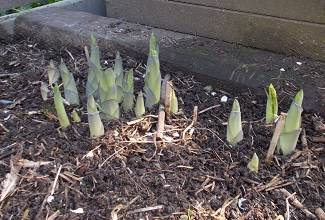
Rudbeckia fulgida 'Goldsturm' makes an excellent garden plant with its masses of intense yellow flowers with dark prominent conical disk centres from July to October, sometimes even November if the weather stays warm. The plant can make a huge impact planted in bold drifts with other late summer-flowering perennials. At its height, it is a mass of striking yellow, daisy-like flowers that the blue-grey foliage is barely noticeable.


Rudbeckia fulgida 'Goldsturm' is a tough herbaceous perennial forming clumps that grow symmetrically from the centre to 60cm in height, with erect stems bearing narrowly ovate leaves. It can be grown from seed but it is much easier to cultivate from basal cuttings or by simply subdividing existing clumps in spring.
Rudbeckia fulgida 'Goldsturm' can be planted at any time of year, although autumn or spring are the best times. It thrives in either full sun or light shade in a fertile soil enriched with lots of organic matter, which holds plenty of moisture in spring and summer without becoming waterlogged.


Keeping the soil moist, will prolong flowering. Feeding with plant food every couple of weeks in the growing season will encourage more, bigger and better flowers. Plants are compact and bushy and rarely need staking.
In autumn, when the flowers have died and leaves are faded, the plant needs to be cut down to ground level. In addition, plants need to be lifted every 3 to 4 years in spring, as new growth begins, and divided into smaller clumps. Pulling clumps apart in spring ia also a good way to increase the number of plants.


Mandazi Recipe
18 August 2019
Each time I visit Kenya, one of the treats that I look forward to when I visit the Porridge and Rice partner schools is being served with fresh warm mandazi and a hot cup of milky tea that Kenyans call chai. It is a wonderful way to start the day.
Mandazi are often called African doughnuts, although they are not nearly as sweet as doughnuts sold in the West. They are usually triangular in shape, fluffy in texture, and served without any icing or glazing with cups of hot milky tea locals call chai. They can be eaten warm or left to cool down.
Mandazi are made by briefly cooking the dough in cooking oil, a dough made including water, sugar, flour, yeast, and milk. Coconut milk is also commonly added for sweetness. When coconut milk is added, mandazi are commonly referred to as mahamri or mamri. Sometimes shredded coconut is added too. Other ingredients like ground peanuts and almonds are sometimes added for a different flavor.
They are popular in the countries of the African Great Lakes region. They are commonly made in the early morning or even the night before, then eaten with breakfast, and re-heated in the evening for dinner. They can be eaten as part of a meal or as snacks by themselves. They can also be eaten as a desert served with dips, often fruit flavored or powdered with cinnamon or sugar.


Ingredients
- 2 1/2 teaspoon baking powder
- 1/3 cup sugar
- 1/2 teaspoon salt
- 2 cups all purpose flour plus more
- 2-3 Tablespoons grated coconut or coconut flakes
- 1/2 teaspoon crushed cardamom spice
- 1/2 teaspoon grated nutmeg or cinnamon
- 1/2 cup coconut milk
- 1 large egg
- 3 tablespoons melted butter or margarine
- warm water as needed
- Powdered sugar or cinnamon sugar to sprinkle
- Vegetable oil for deep-frying
Instructions
- In a large bowl combine all the dry ingredients, flour, sugar, baking salt, sugar, cardamom spice and nutmeg. Whisk together.
- Gently add all the liquid ingredients, eggs, butter and milk. Combine until mixture comes together and dough is smooth. If it is too sticky add a little bit of flour. If too hard add a little bit of water. Dough should not be too sticky, when touched, err on the side of less flour than more flour.
- Roll out dough in to 1 inch thick. Cut intp triangles.
- In a large sauce pan pour vegetable oil, until it is at least 3 inches (or about 5 centimeters) high (too little will result in flatter mandazi and place on medium heat until oil is 350 degrees.
- Fry until golden brown about 3-5 minutes depending on size. Remove with a slotted spoon and drain on paper napkin.
- Serve warm
Chinese Painted Quail
8 July 2019
Chinese Painted Quails are the smallest member of the quail family producing the tiniest little chicks about the size of the bumble bee. As ground dwellers, they are frequently kept on the bottom of outdoor aviaries to pick up seed dropped onto the floor by other birds. They mainly eat seeds but sometimes loves the odd insect. They are easy to keep.
Chinese Painted Quails are very active, running up and down on the bottom of the aviary. Although they are ground dwellers, they fly well and can clear a 2m fence. If they get a fright, they boink which means they fly straight upwards. When they see something new, they will stop and stand on tiptoe until they feel the item is safe, and will then approach.
They are active, entertaining little birds which are a real delight to keep and watch.



Child Marriage
25 June 2019
Mariama, 13, lives in Niger. Her mother and uncle sold her as a child bride to a local man, accepting £122 from the man for her hand in marriage. Mariama's experience is not unusual, in fact 75 % of girls in Niger are married before they reach 18, and 36 % before they are 15 years old, some as young as 8 years old.
The practice of child marriage is not peculiar to Niger, but widespread around the globe.
- Every year, 12 million girls are married before the age of 18, that is 23 girls every minute or 1 every 2 seconds
- 1,000 girls are forced into marriage every day, some as young as 8 or 9 years old
- 1 in 5 girls alive today were married before the age of 18
- Over 650 million girls alive today were married before the age of 18
- 70,000 girls die in labour every year because their bodies aren't ready for childbirth
Child marriage denies girls their right to make vital decisions about their sexual health and well-being, forcing them to have children before their bodies are ready. It forces them out of education and usually into a life of poor prospects, ill health, violence, or early death. Under international law, early marriage is a violation of children's human rights but despite being prohibited by international law, it continues to rob millions of girls under 18 around the world of their childhood.
There are many reasons why families marry daughters off early including
- younger wives are considered to be more obedient
- girls are seen as an economic burden
- families believe that early marriage will protect girls from sexual violence
- family 'honour' and girls' virginity is maintained
- the older a girl gets, the higher the dowry
- marriage to a man of influence can be a useful alliance
- settling a debt or obligation
- laws protecting girls aren't enforced
- women and girls occupy a lower status in societies
In countries like Kenya where many husbands demand that their wives are totally obedient to them, a child-bride is highly desirable because being young, she will be easier to discipline and train. By contrast, the older the girl, the more likely she is to have her own opinions and wishes which might lead her to question her husband or to want to explore her own choices in life, completely unacceptable to a traditional husband.
A good wife will have only one desire and that is to please her husband in every way that he wishes, cooking his meals, cleaning his home, being available for sex when he wants, and raising his children. A good wife simply has no wishes, dreams, or desires of her own, other than to serve her husband obediently and without question. It is thus a truly fortunate man who secures himself a very young bride of say 8 years old as he can train her to submit to him completely.
Because young wives are highly desirable, the poor can use their daughters to raise funds, settle debts, or build alliances. May a young child has been 'sold' into married for relatively small amounts of cash or to settle a debt. In the event, that an influential man is interested in a young wife, there can be competition among families for their daughter to be chosen, and the girl's age will not stop parents agreeing the marriage if a valuable alliance can be formed.
Raising a child is expensive, a heavy burden for the poor who often have relatively large families sometimes reaching double figures, and then after years of spending money on her, a daughter will leave her parents to marry and become part of another family; in essence the money spent on raising a daughter will provide no benefit to her parents. By contrast, a boy will live on with his parents when he gets a job thus increasing the family income as well as continuing to provide for his parents until they die. Boys are thus a great investment well worth spending money on.
The poorer the family, the harder it is for parents to pay for basic needs like food and clothing, so the greater the pressure to reduce expenses and focus the small income of the family where it will yield a return such as sending sons to schools. The girl's age will not be allowed to get in the way if a suitable husband is found for a daughter, in fact, quite the opposite because the sooner the child is married off, the sooner the family no longer needs to provide for her. Poverty has driven girls as young as 8 years old to be married off, often to much older men, especially if they have standing in the community. It is thus not unusual for a tribal chief or elder to have multiple wives after adding a young one every few years. Disasters and emergencies make matters worse because it is often the poorest households that bear the brunt of any devastation.
A girl who loses her virginity before marriage brings great shame to the family. It does not matter whether the girl loses it of her own volition or by force, the shame is no different for the family, after all a girl who gets raped must 'have done something to tempt the man'. Both the girl that has been raped and her family will be scorned and mocked, even shunned by the entire community. She has no chance of finding a husband and her parents will have to provide for her for life. Marriage solves the issue for parents because it shifts the responsbility for protecting the girl's sexual honour to the husband and according to many traditional people, marriage reduces the chance of the girl being abused because she will be too busy caring for her husband.
Most countries have laws against child marriage but in some parts of the world they are simply not enforced either because of corruption, a lack of committment, or rejection of 'western ideas imposed by foreign powers'. Corruption is widespread in many third world countries and men wanting a young wife can frequently afford to bribe local officials both within the tribe and in law enforcement if anyone objects to the girl's age. In addition, in these countries, politicians and the authorities consider enforcing the laws against child mariage to be of low priority, laws sometimes introduced only to silence the criticism of first world countries and organisations like UNICEF. In some of these countries, many communities see the prohibition on child marriage as the west forcing its values on traditional societies. For these people, child marriage is a positive rejection of what they perceive to be colonial and imperialist values in favour of their traditional norms. In these communities, men will frequently have multiple wives marrying a new young wife every few years as opportunity and finances allow.
In many countries, girls are simply not recognised as equal to boys. Whether the rational is religious, cultural, or traditional, this belief that girls are inferior to boys is so deeply engrained into every aspect of a society that most girls actually believe that they are worth less than their brothers. It restricts what girls are allowed to do and ensures severe sanctions for girls that push the boundaries imposed on them. As a result, families will do everything they can to keep their sons in school while girls are frequently not educated beyond the primary years when they are then kept at home to take care of the house, cooking and cleaning while boys are allowed to play football with their friends. The men and boys are fed first while the women and girls serve them, and girls are sent out to collect water while boys relax. Among the Massai, men are considered to be warriors whose sole task is to protect the tribe and its wealth in the form of cattle while the women do literally everything else including building houses for the family. Among the Masaai, it is not unusual for for very young girls (4, 5 or 6 years old) to walk miles to fetch water for the family while their brothers relax with the men or take the cattle out to graze.
Child marriage ruins the lives of millions of girls every year and robs society of the contribution they could make towards building a wealthier, fairer, and more just society.
While enforcing laws or stiffer penalties, can play a part, they will not end child marriage on their own. As has been showing many times, education is the only way to stop child marriage - the education of parents, the education of children, the education of the community, and the education of community leaders. Educating girls about their rights, the consequences of being married as a child, and who to contact if they find themselves facing the prospect of being married of as a child, educating parents so they understand the benefits of keeping their daughters in education, the consequences for their daughters if married as a child, and the law on the subject, and educating community leaders from tribal chiefs to teachers as they are able to influence parents and girls to change their beliefs on child marriage. The most effective education stresses the many benefits of according girls the same value as their brothers such as the fact that girls can also be successful, earning good salaries and support their parents as they age. Child marriage can only be ended when societies recognise that values girls and boys equally, will benefit them and the girls.
Porridge and Rice, an education charity in the Nairobi slums takes a firm position on child marriage running sessions for both parents and pupils on the consequences of child marriages compared to the benefit of keeping girls in school allowing them to choose their own futures. The charity looks to the teachers in each of the five partner schools that it supports to be champions for the girls in their communities, persuading parents and guardians to let them shape their own lives.


Scented Sweet Peas
16 June 2019
I grow sweet peas every year in my garden testing new colours and varieties as they take my fancy. They are without doubt one of my favourite garden flowers.
This year I am growing scented sweet peas. As much as I love the giant blooms of many of the modern hybrids, the powerful scent of sweet peas in the garden of an evening is so enchanting, that I am accepting beautiful although slightly smaller blossoms in preference for that gorgeous evening scent.
I planted many more sweet peas than my garden can accomodate and am selling those I do not need to raise money for Porridge and Rice.


Porridge and Rice Young Volunteers
2 May 2019
Volunteers of all ages make it possible for Porridge and Rice to raise money in the UK to fund its work in Kenya. Volunteers as young as 10 years of age have made and continue to make a valuable contribution to the work of Porridge and Rice.
Young volunteers meet each weekend to undertake a range of tasks from planting tomato seeds to washing guinea pigs, all in order to enable Porridge and Rice to raise money for the charity's work in Kenya. They are special people who willingly give up their free time to work for people living in poverty. They are as important to achieving the goals of the charity as are all its volunteers.
Izzy, George, and Jamie spent Sunday morning 28 April cleaning the guinea pig cages and then grooming the guinea pigs, as well as filling plastic cups to be used for sowing tomato seeds. In between tasks, they handled and petted the baby guinea pigs and the young African Pygmy Hedgehog to get them comfortable with being stroked and held by people as part of the charity petting zoo.
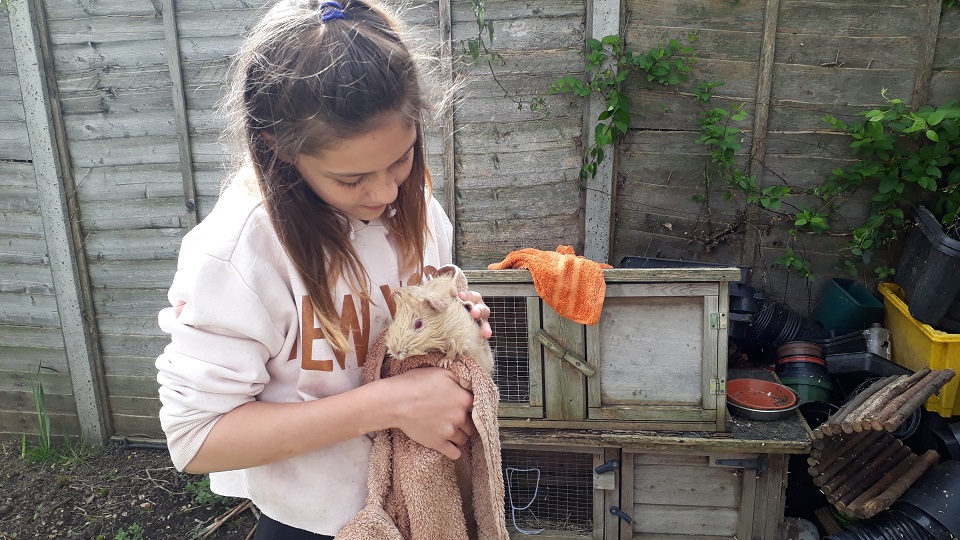


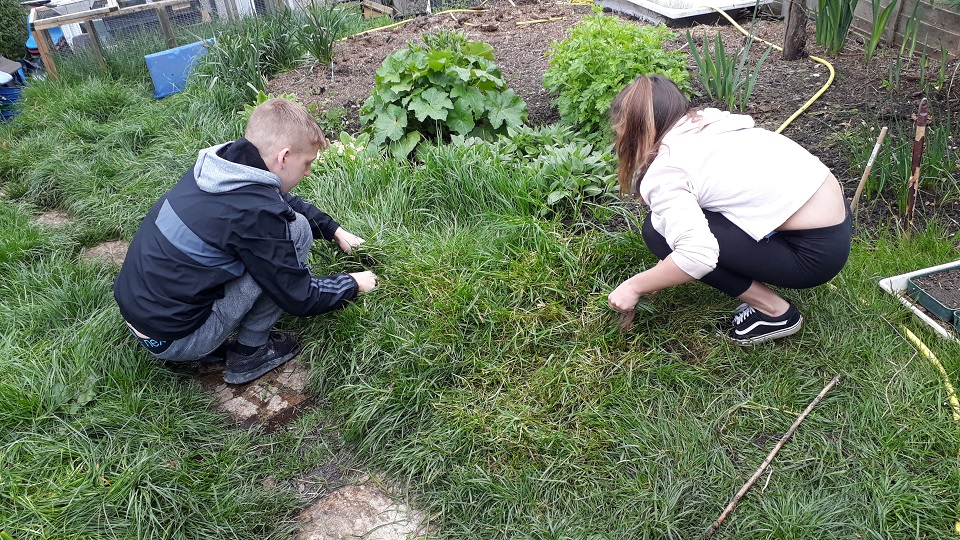
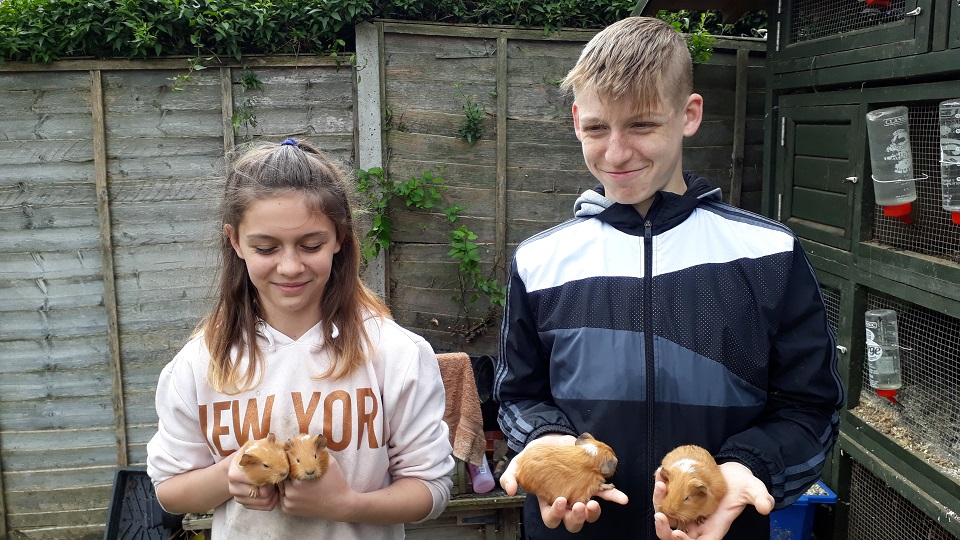
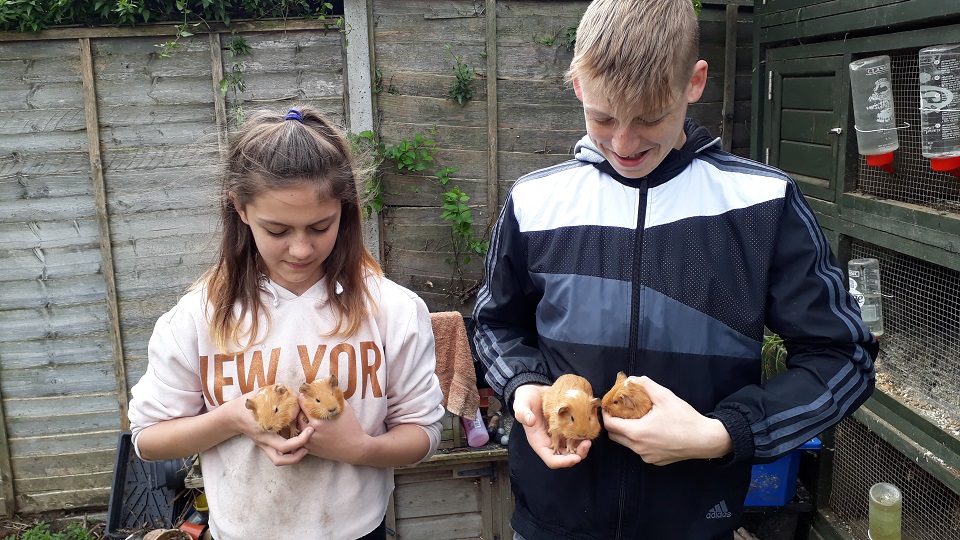
Garden Colour
6 April 2019
Despite the inconsistent weather, my garden has been full of colour for several weeks now, ever since the first snowdrops appeared above the soil.
My daffodils were very disappointing as the slugs and snails got to them before they opened, and then the unexpected hail stripped a lot of the flowers off my magnolia, but other than that, the spring bulbs and flowers have brought life to the garden. The primroses, one of my favourites, have been as wonderful as ever, and my red tulips are just as striking each year.




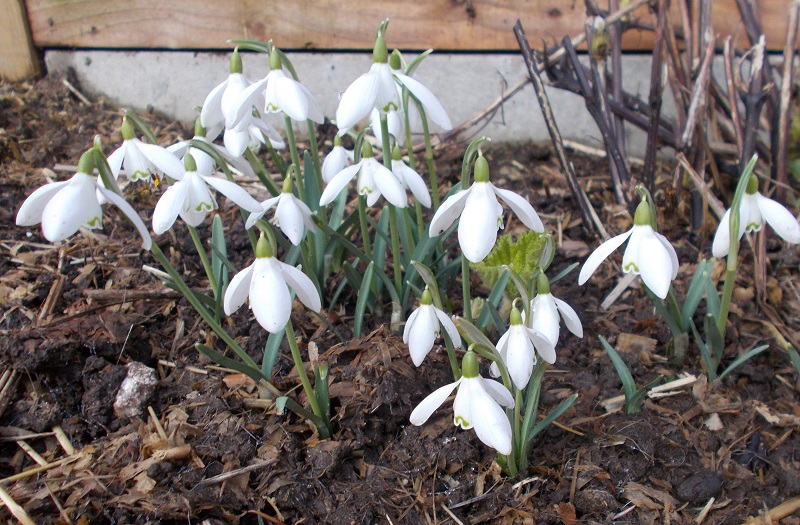
Petting Day 31 March
2 April 2019
Another very successful petting day took place on Sunday 31 March 2019 with people coming from all around the area.
The frizzles, newly hatched chicks and hedgehogs were popular but without question, the baby guinea pigs got the most attention, with people 'oohing' and 'aahing' while large-eyed guinea pigs fell asleep in their hands. Almost, on cue, two chinese painted quail hatched on the day so guests were able to see them right out the egg.
Most importantly, the event raised money to support the work for Porridge and Rice. All helpers were as usual volunteers, so every penny raised goes to the charity's work in the Nairobi slums.


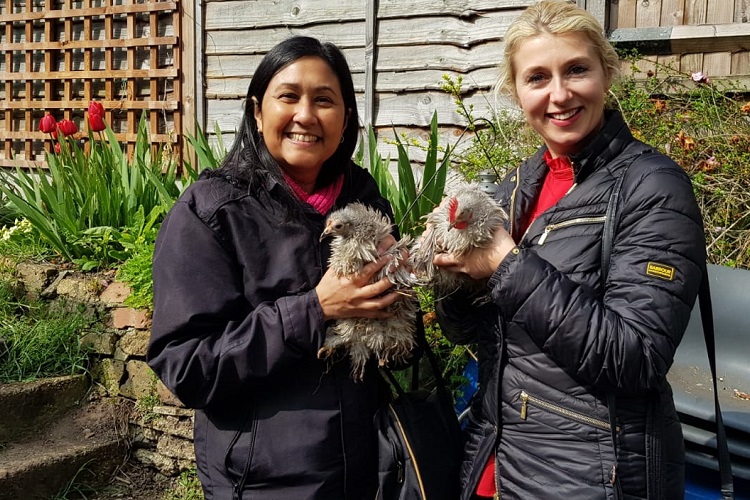


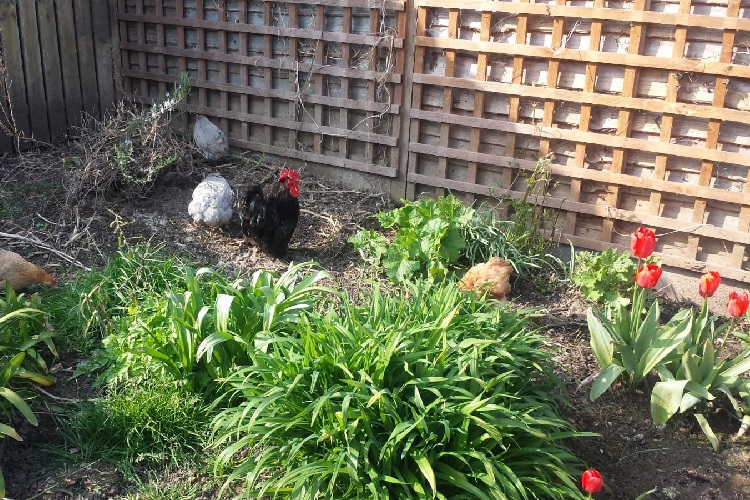


Jacoby 2NT
18 March 2019
A response of 2NT to an opening bid of 1H or 1S is known as Jacoby 2NT. It promises
- 13 or more points
- 4 or more cards in the opener's suit
If opener has a minimum hand, he will call game signaling that he cannot go further. Unless responder has an exceptional hand, this is a sign off.
On the other hand, if opener has more than a minimum hand, he should describe it so that his partner can consider whether a slam is possible.
The Jacoby 2NT convention includes a number of bids for describing the opening hand further. Assuming opener bids 1H and responder bids 2NT, the opener has the following bids available -
| Bid | Explanation |
|---|---|
| 3♣ | singleton or void in clubs |
| 3♦ | singleton or void in diamonds |
| 3♥ | shows 17+ points, interest in slam, asks responder to describe his hand further |
| 3♠ | singleton or void in spades |
| 3NT | good 13-15 points, balanced, no singleton/void |
| 4♣ | 5+ clubs, good suit with 2 or 3 honours |
| 4♦ | 5+ diamonds, good suit with 2 or 3 honours |
| 4♥ | a minimum hand of 11 to 14 points, a sign off bid |
| 4♠ | 5+ spades, good suit with 2 or 3 honours |
While playing Jacoby 2NT does mean giving up a natural 2NT bid (balanced shape, 10-12 points), the loss is generally considered worthwhile because
of the effective way Jacoby 2NT allows pairs to explore slam.
Partner must alert Jacoby 2NT.

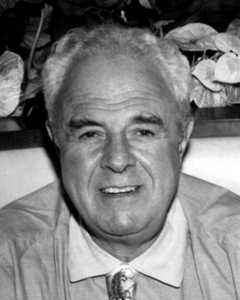
Volunteering in Kenya
7 March 2019
Every year in the summer, I take groups of volunteers to Kenya for several weeks to work in Porridge and Rice partner schools in the Nairobi slums. The trip benefits both the volunteers and the charity schools.
The volunteers get to know people whose lives are very different to their own, people who are among the poorest of the world. The volunteers are made aware of the huge advantages they have because of where they were born and live and they see first hand that not all people are as fortunate, through no fault of they own. It challenges them to think about those living in poverty and to consider how they can be a part of building a more just world where all people can share in its wealth and resources.
In addition, the volunteers complete tasks that are needed by the schools including painting classrooms, teaching good hygiene habits, and improving the subject knowledge of teachers and pupils. They make a real contribution to achieving the goals of the charity of breaking the cycle of poverty through education. Volunteers are important to Porridge and Rice.
Finally, it is an opportunity to see some of the wonders and attractions of Africa, a vast, beautiful continent, including white-water rafting through woodlands under the gaze of Vervet monkeys on the Tana River, watching herds of elephant crossing the savannah in search of the cool water and mud of the Amboseli marsh, and taste local meats at dinner at the famous Carnivore restaurant.
Anyone interested in volunteering in Kenya can see photos from previous trips and fill in an application form to learn more.


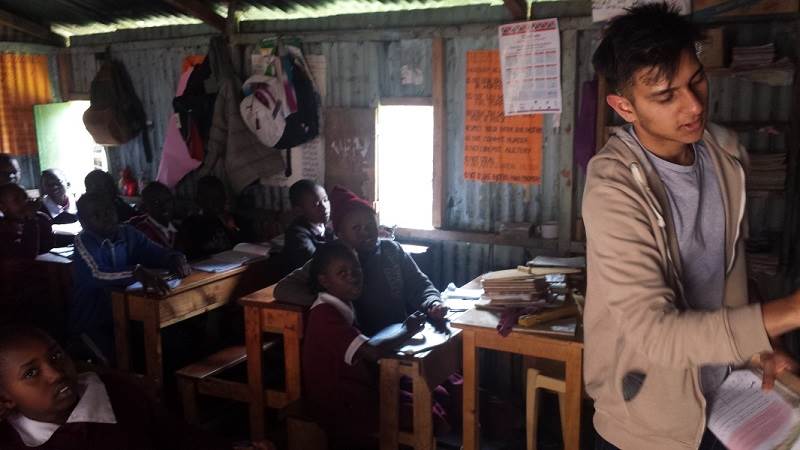

Fox Tossing
19 February 2019
I discovered recently that fox tossing was a popular sport in the 17th and 18th centuries among the members of the wealthy classes and nobility across Europe including in England.
The game was played in an arena with teams of two people each with their own sling. The sling would be laid out on the ground with a member of the team standing at each end holding the sling about 20 feet about.
When the all competing teams were in place, the foxes would be driven into the arena. The animals would rush around the arena and when one crossed a sling, the pairs would fling the fox as high as possible into the air by pulling the sling taught. The hightest recorded height was 7.5 metres.
The foxes were usually seriously injured or killed, and those that did not die when they fell back to the ground, were tortured then clubbed to death after the event. A Swedish herald wrote in March 1672 that he was surprised to see the Holy Roman Emperor Leopold I joining the court dwarfs and boys in torturing the animals. He felt that the company Leopold was keeping was demeaning but said nothing about the way the animals were being treated.
People would usually wear elaborate fancy dress for the event - Roman warriors, centaurs, jesters, goddesses, and nymphs were popular outfits - and the animals were sometimes decorated in colourful fabrics and adornments. The event was frequently followed by dinner.
Other animals like badgers, wildcats and hares, were sometimes tossed. In 1919, a book talking about tossing wildcats said that "they do not give a pleasing kind of sport, for if they cannot bury their claws and teeth in the faces or legs of the tossers, they cling to the tossing-slings for dear life, and it is next to impossible to give one of these animals a skilful toss."
Large numbers of animals usually died at each event. For example, Augustus II the Strong, the King of Poland and Elector of Saxony, held an event in Dresden at which 647 foxes, 533 hares, 34 badgers, and 21 wildcats were tossed and killed, all in one day.


1NT bid with a 5 card major
17 February 2019
An opening bit of 1NT signals a balanced hand of 12 to 14 HCP points. While evaluating the the point count is easy, whether the hand is balanced includes some interesting subtleties.
The traditional definition of a balanced hand is
• no voids or singletons
• no more than one doubleton
• no five card major - it is usual to bid 1NT with a 5 card minor
The traditional thinking is that one should never deny a 5 card major but there are hands where one can reasonably argue that it is better to bid 1NT because the 5 card suit is too poor to rebid and no other option is available.
Hand 1
♠ A Q 10 3 2
♥ J 8 3
♦ Q 4 2
♣ A 7
Considering hand 1, what would the rebid be after an opening bid of 1S? None of the other suits are long enough to bid (a second suit from opener promises a 4 card suit) and the hand is not strong enough for a NT bid, so the only choice is to rebid the spade. On this occassion. the spade suit looks good enough for a rebid so opening 1S makes perfect sense.
Hand 2
♠ 10 8 7 3 2
♥ A J 3
♦ K 4 2
♣ A J
Hand 2 fits all the criteria for a 1NT opening bid except that it contains a 5 card major suit. So consider what happens if you bid 1S and your partner rebids say 2C.
Bidding hearts, diamonds or clubs promises 4 of the suit, but this hand has no 4 card suit, so it would be misleading partner, even if supporting a suit bid by partner. There are time when opener is forced to support partner with only 3 of a suit, but this should only be after all better options have been explored.
Rebidding spades seems to be an option because there are 5 cards in the suit but it is a really poor suit. It doesn't seem like a good option, unless there are no other options.
What about 1NT?
A 1NT opening bid with this hand has much to commend it- it describes the hand well and does not rule out a major contract. If partner has a 4 card major, then Stayman will test for a fit, and with a 5 card suit, partner can use a transfer to signal the 5 card suit.
The idea is that 1NT should be considered with a poor 5 card suit especially where there is no obvious rebid.
There is of course no hard and fast rule, after all, one of the delights of Bridge is that it is a matter of taste and judgement blended with skill and tactics, which probably is why it attacts so many great minds like Warren Buffet and Bill Gates.
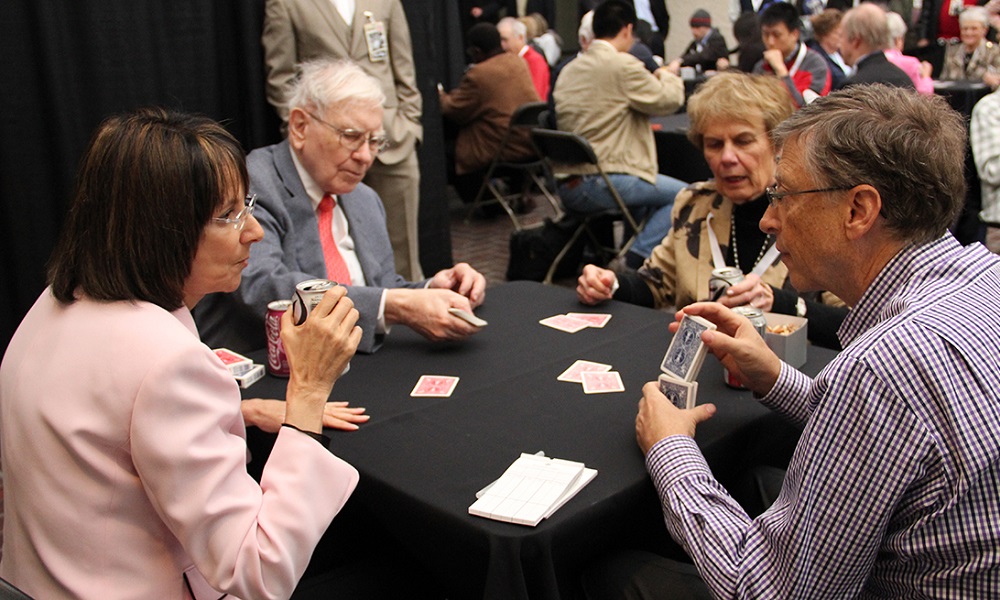
White Collar
11 February 2019
One of my students recommended the tv progamme 'White Collar' to me, centred on the white collar crime division of the FBI, and I am thoroughly enjoying it. Although, it isn't a recent series having aired from 2009 to 2014, it hasn't aged.
The plots while mild compared to many recent crime series, are highly entertaining. However it isn't the plots that give the show its charm but the main characters. Peter Burke, an FBI agent, who believes in 'the system' and thus finds it hard to bend rules, works alongside and manages convicted conman Neal Caffrey, making for a complex and fragile relationship, where the two men become very close yet are constantly troubled by how much to trust each other with their very different histories. Added to the mix is Mozzie, very close friend to Neal Caffrey, and a highly accomplished conman, like his friend, who is inherently suspicious of anything linked to the government, embracing numerous conspiracy theories.
It is a show that deserves to be recommended which I suspect will continue to be popular for a long time yet.

Snowdrops
29 January 2019
The first flowers in my gardens to announce the onset of spring are the snowdrops. I have little clumps around the garden that force their little white heads through the ground to create patches of bright white. I love snow drops more than any of the other spring bulbs from daffodils to tulips. I am not exactly sure why but maybe it is the vibrant patches of snow white that they create, dotted about a dormant garden.

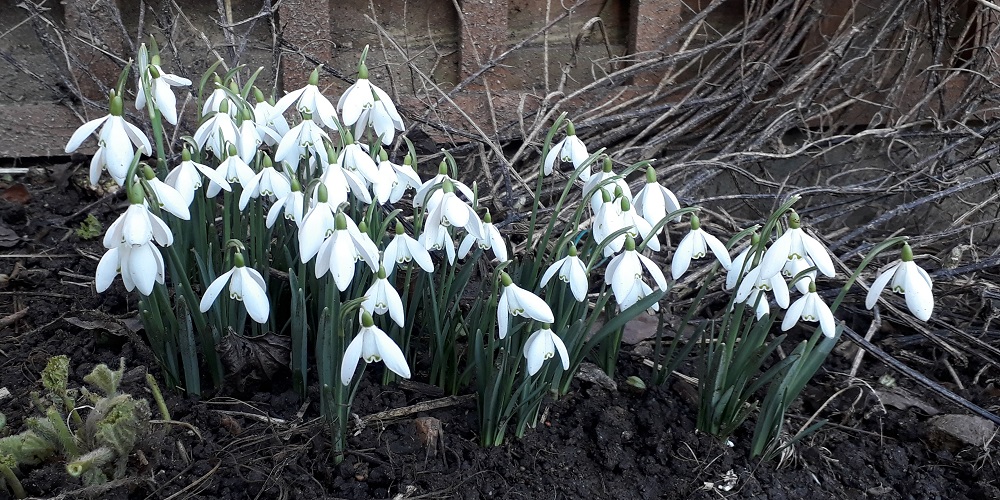


Extreme Poverty
25 January 2019
In 2015 10% of the world's population lived on £1.45 a day down from nearly 36% in 1990. In terms of people, there were 1.85 billion extreme poor in 1990 reduced to 736 million in 2015.
There has been very real progress in reducing poverty but there is still a lot more to be done. The UN goal is to eliminate extreme poverty by 2030.
In East Asia, the Pacific, Europe, and Central Asia, extreme poverty have been reduced to below 3 percent. Currently, more than half of the extreme poor live in Sub-Saharan Africa where the number of poor has actually increased by 9 million, with 413 million people living on less than US$1.90 a day If the trend continues, by 2030, nearly 9 out of 10 extreme poor will be in Sub-Saharan Africa.
I am proud to be associated with Porridge and Rice, an organisation working to combat extreme poverty in the slums of Nairobi.
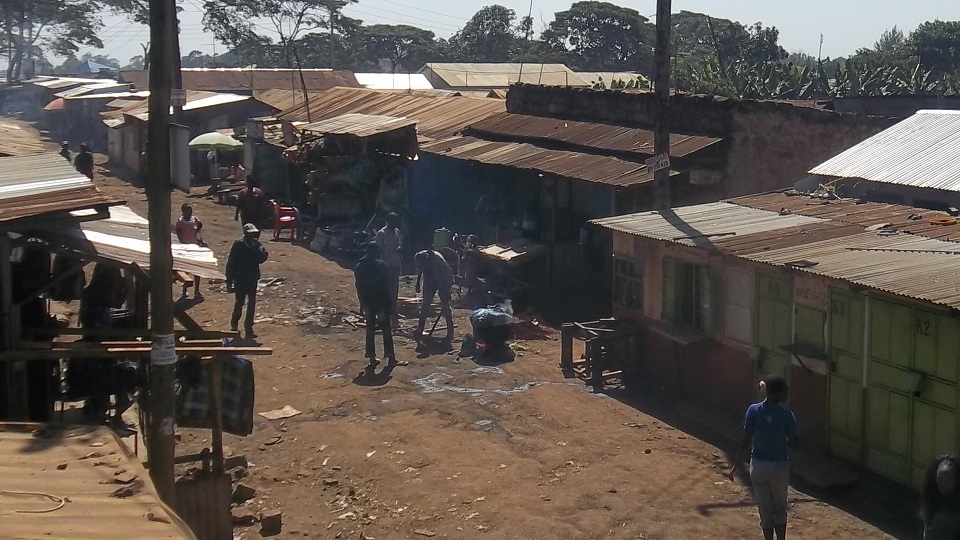
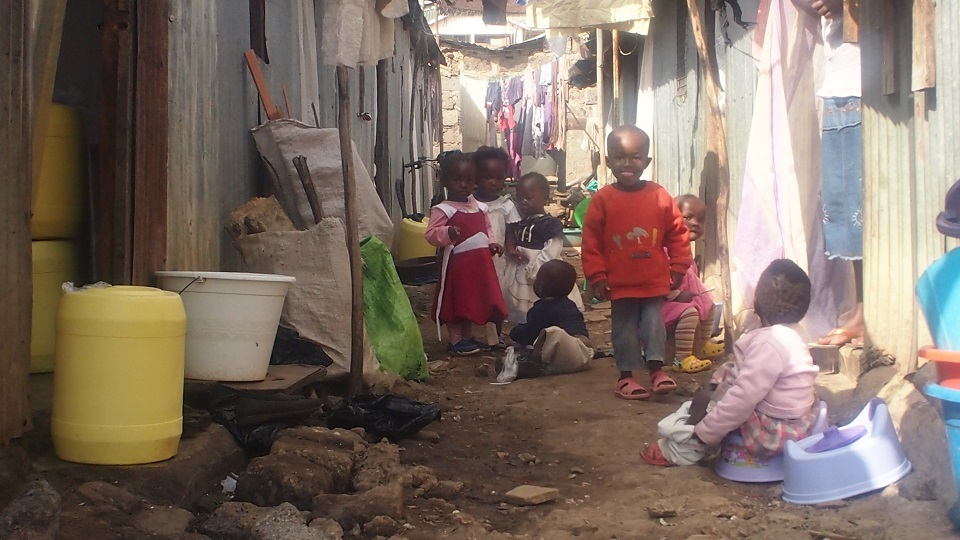

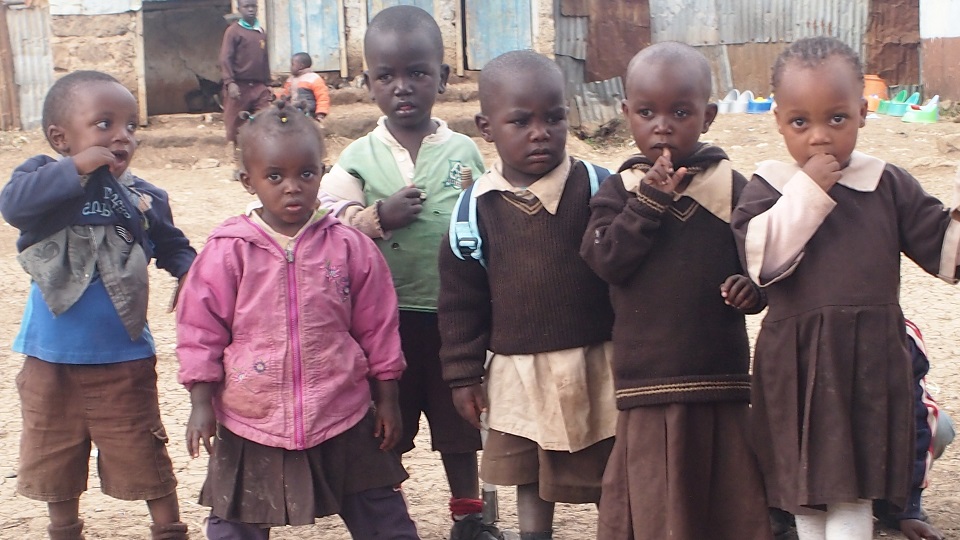
Christopher Brookmyre
20 January 2019
There is something about the writing of Christopher Brookmyre that really appeals to me. I have now read four of his books - Quite Ugly One Morning, Country of the Blind, Not the End of the World, and One Fine Day in the Middle of the Night - and I have not been disappointed by any of them.
He has a dry, dark sense of humour that makes me laugh out loud, something few books have ever achieved. It is never clear until the last minute that he is about to be funny. You read a sentence almost to the end and with a flourish of a few words you suddenly realise he is being humorous. The element of surprise enhances the joke.
He places his characters in slightly surreal situations that keep you reading on in anticipation of what might happen, and just close enough to reality to be believeable. I found myself thinking 'really??" quickly followed by 'it could happen' a lot while the plot unfolds.
He is a master story teller. The book and characters of every book have gripped me, and I find myself more and more reluctant to put a book of his down - "just one more chapter" has seen me sitting up late to read more.
Amboseli
16 January 2019
I am in Kenya two or three times a year because of the charity that I chair, Porridge and Rice and in my off time, visited Amboseli, three times now. It is my favourite park in Kenya.
Amboseli is my famous for its elephant, and quite rightly so. The herds traipsing to and from the marsh, and bathing in the mud, are a magnificent sight. I would be happy to sit for hours just watching these wonderful animals.
Sadly, many people still see them as a source of a saleable product ivory, and there are people in the world still willing to buy this product. Progress has been made to end this awful trade, but there is a lot more to do.

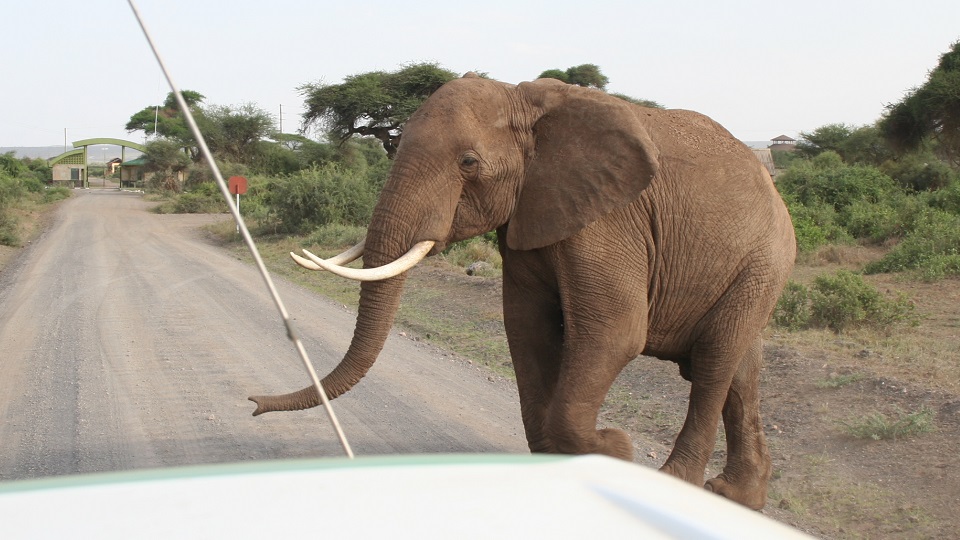


How to learn
10 January 2019
I am regularly asked how to learn by my students, and the simple fact is that there is no better technique than the traditional read, cover, and repeat (RCR).
Students are looking for some great insight that is easy to implement while yielding outstanding results, so are usually disappointed to be presented with a technique that requires effort and discipline. There is no such technique and it is a waste of time to look for one.
The good news is when you start to use RCR, it becomes a habit that gets easier with time, and more importantly, it produces results.


Excel School
5 January 2019
In late 2014, I travelled to Kenya with a group of my students, to volunteer in Nairobi. It was a seminal moment that lead to the foundation of Porridge and Rice, the charity that I chair.
It was a very moving experience, that made the group want to do something. After research and careful thought, the decision was made to start by supporting Excel school in Ngando, led by two people that had impressed all of us. The idea was to enable them to provide the children of their part of the Nairobi slums with a sound education.
With the support of the charity, the school has gone from strength to strength. It has doubled in size with improved facilities and new services such as clean water and lunch.
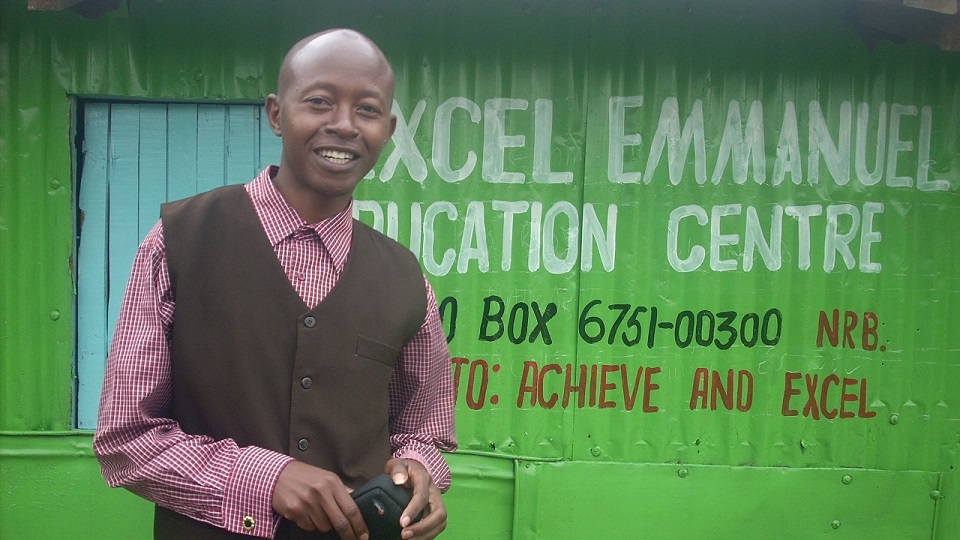

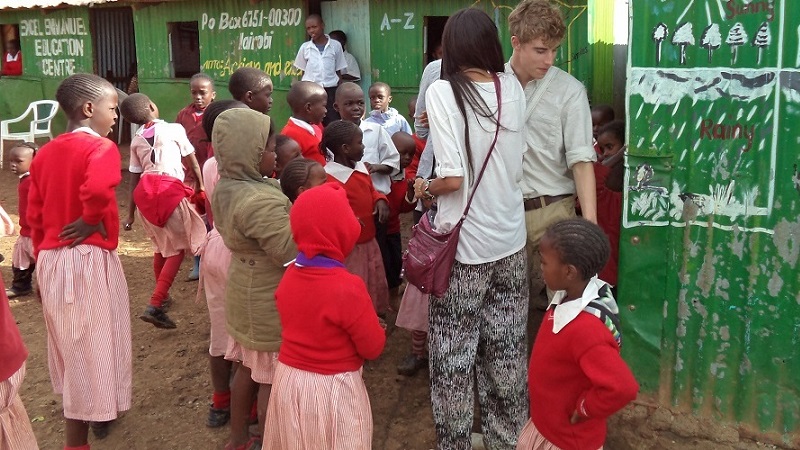


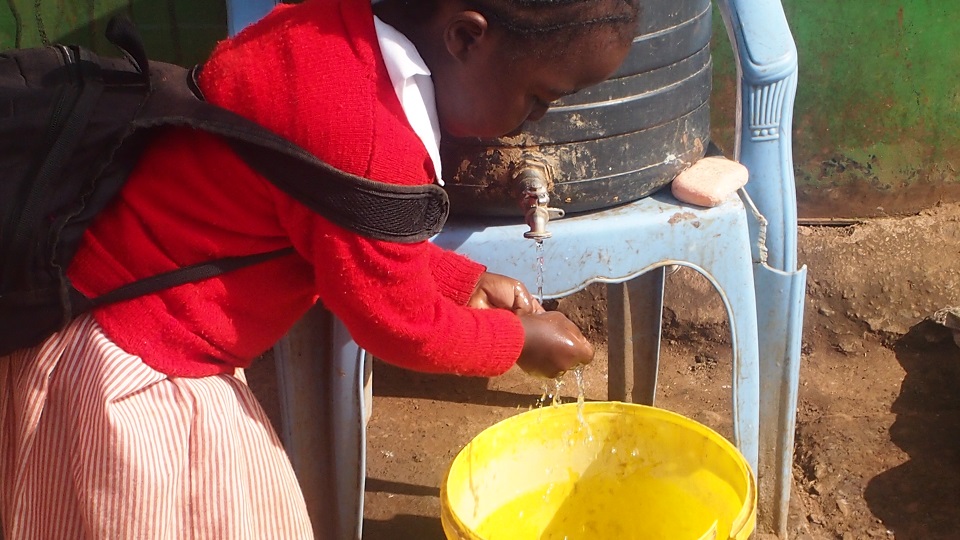
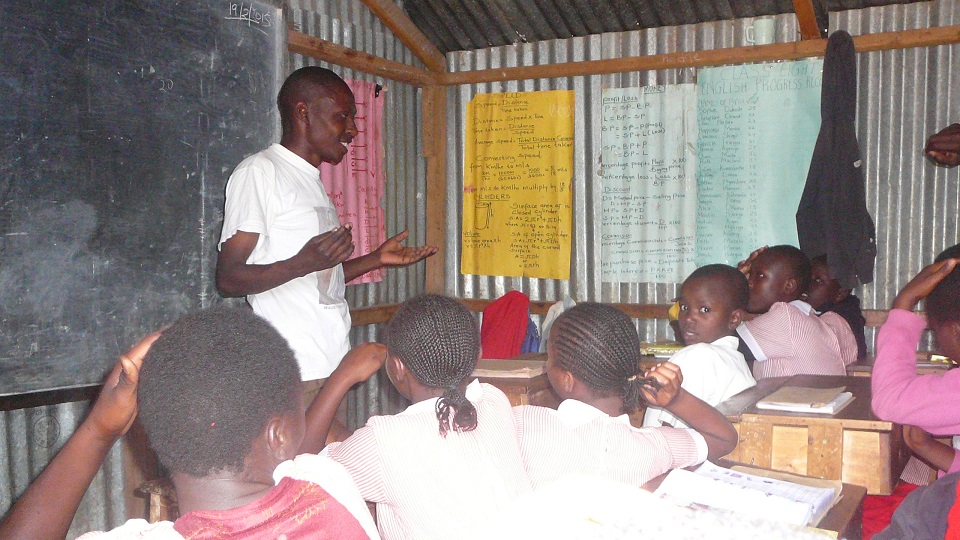
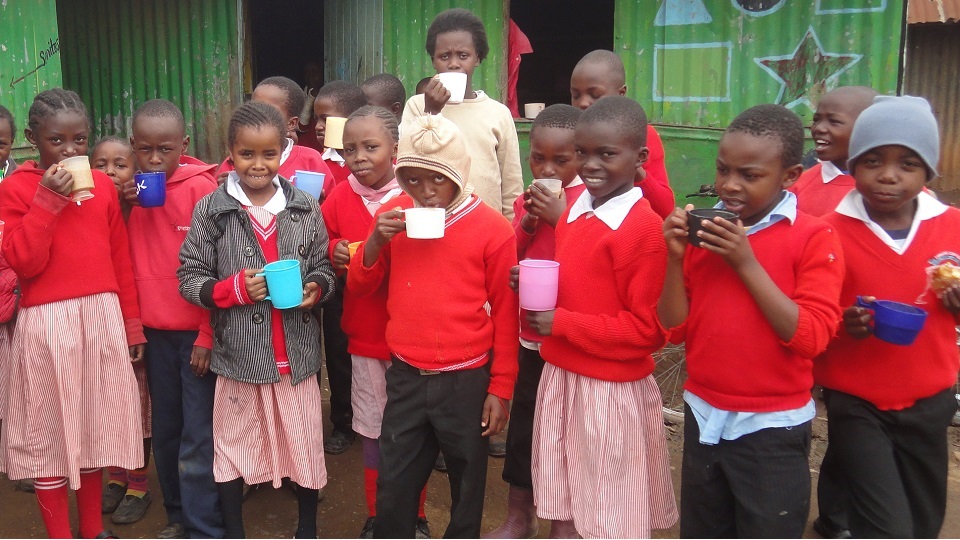
Education and Poverty
28 December 2018
According to the UNESCO Global Education Monitoring Report, 171 million people could be lifted out of extreme poverty if all children left school with basic reading skills. That is equivalent to a 12% drop in the world total of extreme poor.
According to the UNESCO Institute for Statistics and the Global Education Monitoring Report, 420 million people could be lifted out of poverty with a secondary education, thus reducing the number of poor worldwide by more than half.
Numerous studies confirm that poverty and education are inextricably linked, and that education is one of the most powerful ways to reduce poverty and improve health, gender equality, peace and stability.
The charity Porridge and Rice is thus committed to enabling the children of the Nairobi slums, home to many of the world's poorest people, to get a sound education, helping to break the cycle of poverty and deprivation.

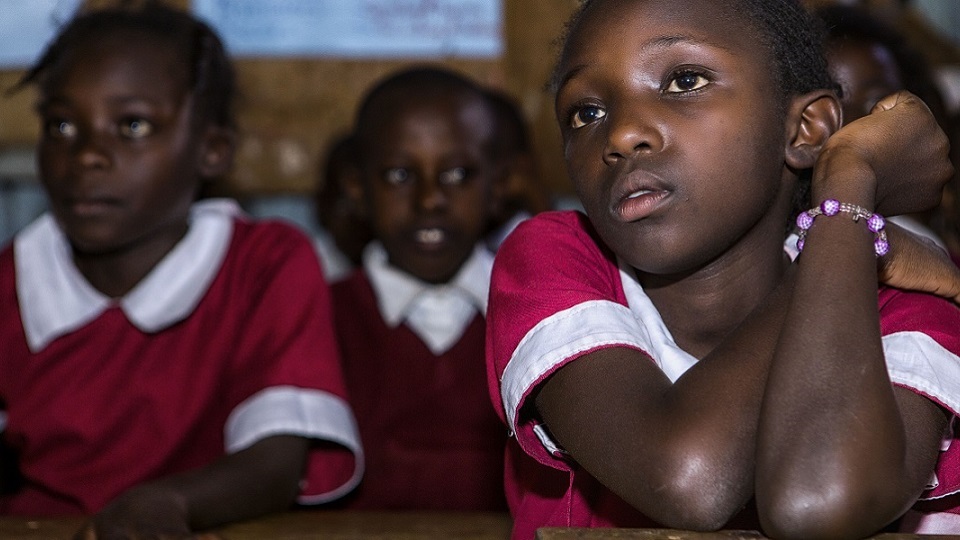


Jonas Jonasson
19 December 2018
I picked up 'Hitman Anders and the meaning of it all' and was hooked.
It has been a long time since a book has made me laugh out loud, so long that I cannot remember the last time, so it came as a real surprise the first time it happened when reading Jonas Jonasson and an even bigger surprise when it kept happening.
His books are not just comedy and farce, but offer serious comment on current events. He clearly does his homework and has strong opinions on world affairs and events.

I was genuinely impressed by his knowledge of South African politics during the apartheid era and loved his portrayal of Donald Trump. With just a few words and a single event, he is able to demonstrate the buffoonery of the man. He doesn't pull his punches, and reaches far and wide across history and politics in his comment like his single mention of Theresa May who was 'too busy destroying her own country' to be able to help.
I enjoyed the first book so much, that I have worked my way through all five. My only disappointment is that he has written so few.


Verbena Bonariensis
11 December 2018
Verbena bonariensis can be used to create swathes or spots of lavender-purple flowers in summer to autumn. It grows up to 2m in height with numerous branches of clumps of bright, small flowers. It is a beautiful tall perennial that adds colour and interest to the garden with its tall stems and bright flowers.
It's perfect for bringing height to an ornamental border and also works well in planting schemes with ornamental grasses. It's a superb butterfly plant, rivalling even buddlea and goes well with Cosmos 'Purity'
Verbena bonariensis prefers sun and is easy to grow, returning year after year often seeding freely in the garden. Other than needing to be cut back before it starts to regrow in Spring, it requires virtually no attention. A deep, dry mulch in winter can help protect the plant from extreme cold.
Position: full sun
Soil: moist, well-drained soil
Flowering period: June to September


Egon Schiele
2 Decemember 2018
Egon Schiele's work is as fresh and vibrant today as it was when he created it. Looking at it, it is hard to believe that he died over 100 years ago. He was a great painter, a revolutionary and a genius.
The bright colours, brazen nudity, and twisted poses make the viewer uncomfortable but unable to look away. They are both beautiful and disturbing in equal measure. They ooze unbridled lust verging on the pornographic.
I am looking forward to visiting the Klimt/Schiele Exhibition at the Royal Academy from 4 November 2018 to 3 February 2019.



David Davis - stupid or delusional?
21 November 2018
I read David Davis article on the Conservative website with disbelief and terror. The man was the Brexit secretary for 2 years and should know better. I can only conclude that he is dangerously delusional or incredibly stupid. Jon Worth, visiting professor in EU policy at Bruges College of Europe, tweeted "How the sodding hell has Britain had a Brexit Minister (Davis) who does not even understand the basic scheduling of the process? Or is he so mendacious or lazy he doesn't want to understand?".
The idea that the UK will benefit from a Canada type deal in the same way as Canada has, is the most dishonest claim in the article. Canada negotiated improved trade terms from the default WTO position under its deal with EU. The UK is in effect reducing its trade terms by chosing a Canada type deal. For example, as full EU members, the UK can sell services to all other EU without any barriers, something which has been a great benefit to the financial sector. This will disappear under a Canada type agreement which considers only goods and not services. The financial sector is hugely important to the UK economy meaning that losing what are known as passporting rights, will hurt the UK economy along with jobs and investment. Compared to where the UK is now, a Canada type deal is a set back for UK businesses, not to mention environmental standards, human rights, peace, and more.
His trivialising of the Irish border question is irresponsible, if not downright criminal, not to mention insulting to the people who fought to end the violence, sometimes dying as a result of their efforts. It demonstrates that he has no appreciation of how difficult it was to negotiate an end to the bloodshed and how sensitive the situation is in Northern Ireland. I sincerely hope that it never happens but if republicans feel that their ties to the Republic of Ireland are being undermined, they could very well decide to return to violence.
In addition, his belief that it is possible for the UK to be outside the Customs Union without a border of some sort between the UK and the Republic of Ireland, shows that he has absolutely no idea whatsoever of how Customs works and the importance of the EU to peace in Northern Ireland. The EU will want to know exactly which goods are crossing the Eire-NI border so they can can collect duty on them. How does the man imagine this will happen with some kind of checkpoint or border? The flippant suggest that the problem can be solved with technology has been exposed with experts pointing out that any such solution (assuming it exists) is many years away. Maybe he hopes that smuggling will compensate for lost trade.
Technically, the UK will continue to be a member of the WTO after leaving, however its membership is worthless as the schedules which define trade terms have yet to be agreed. For them to be agreed, all objections have to be approved by members, which is not a trivial task with over 27 countries having lodged objections, "small" countries like China, Russia, the US, and Argentina. Agricultural countries like New Zealand are even suing for compensation because of the added costs them trading with the UK separately from the EU. Schedules will eventually be agreed but they are likely to take a long time and many countries will take this opportunity to extract their pound of flesh from the UK. The cost will be high and the process painful and expensive, and all to achieve a worse position than the UK currently has with world trade.
Other points in his article that demonstrate how incompetent and ignorant the man is, are as follows -
David Davis is not alone. Having campaigned to leave the EU, MP Nadine Dorries today bemoaned the fact that under Theresa May's proposed deal the UK has "no voice, no votes, no MEPs, no commissioner". Her ignorance is as hard to believe as it is frightening. One Twitter user summed up the situation perfectly saying "Ladies and gentlemen, this is the quality of our politicians right now. The intellect of a boiled cabbage."

Playing Bridge
14 November 2018
According to Warren Buffet, Bridge is "the best exercise there is for the brain". He is probably correct about the benefit to the brain of playing Bridge but but I play for the sheer pleasure of the game, any benefit are unexpected bonuses. Buffett also said when talking about Bridge "You know, if I'm playing bridge and a naked woman walks by, I don't ever see her".
I play twice a week for two hours each time at Richmond Bridge Club with my partner Heather. Having only been playing seriously for just under two years, I am still a beginner with a lot to learn.
I read Bridge books like "Winning Ways to Play Your Cards" by Paul Mendelson, and articles to improve my game, and I play on a computer game that I have when I am not at the club. My knowledge is growing steadily but each time I talk to one of the experts, I am reminded how little I actually know and still need to learn.
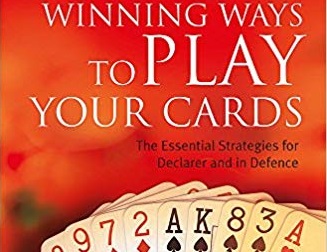
Alchemilla Mollis
3 November 2018
Alchemilla mollis, or Lady's Mantle, is overlooked by many gardeners. It is easy to grow returning year after year and forms attractive clumps of beautifully shaped, textured olive-green leaves and yellowish flowers, yet still ignored by many gardeners.
Alchemilla mollis is a herbaceous perennial so will return year after year only needing old leaves and flowers to be removed each winter. It forms full clumps and self-seeds which is useful if new plants are neededs - plant clumps can be divided in spring or autumn for new planting.
It produces sprays of yellowish-green flowers from late spring until early summer. The flowers are popular with flower arrangers who use them to blend with more prominent cut flowers. If cut back after flowering, it will grow back quickly.
It will grow well in both full sun or shade, and can be used as ground cover, borders, or to create interest in its own right. It is a highly versatile, strong, and attractive plant that will grace any garden.




Robert Newman
2 November 2018
Erudite, eloquent, and funny, Robert Newman continues to provide sharp insight into many current ideas and issues. His current series on Radio 4 takes a look at philosophy and how it often understood or applied in everyday situations from grammar schools to the multiverse hypothesis. Sadly, I only found out after the show had run its course, that he had performed the same material on stage at the Soho Theatre. It takes exceptional skill to be funny about so serious and academic subject.


Why are pumpkins carved on Halloween?
25 October 2018
Every year, hundreds of thousands of pumpkins are carved to make jack-o-lanterns in celebration of Halloween. The tradition seems to have started in the US but is steadily spreading around the world as more and more people in more and more countries celebrate Halloween.
The tradition of carving pumpkins at Halloween actually has its roots in Ireland not the US! Records from the 1600 show that people carved beets, turnips or potatoes to make laterns in Ireland. Then when the Irish immigrated to the US, they were introduced to the pumpkin, and the modern tradition of carving pumpkins was born.
Jack-o-lantern, the name of the carved pumpkin, is derived from the Irish story of Stingy Jack. In the story, Stingy Jack invites the devil to have a drink with him, but as his name applies, he didn't want to pay for the drink so persuaded the devil to turn himself into a coin to pay for the drinks. When the devil obliged, Stingy Jack put the coin into his pocket next to a cross, preventing the devil from changing back to himself. Jack only freed the devil when he agreed that he would leave him alone for a year and would not claim his soul, if he died.
Jack and the devil met up again the next year. This time Jack tricked the devil into climbing a tree to pick fruit. While the devil was in the tree, Jack carved a cross on the trunk so the devil could not climb down from the tree until he promised to leave Jack alone for 10 years, and again not to claim his soul.
Soon after, Jack died but god would not let him into heaven because of his character. However, he could not go to hell either because of the deal he had done with the devil so he was forced to roam the earth forever. So he could see where he was going, the devil gave Jack a piece of coal that would burn forever, and Jack put the coal into a carved-out turnip to make a lantern. Having made his lantern, Jack could be spotted roaming by its glow in the dark or through the fog, so became known as "Jack of the Lantern," which was shortened to "Jack O'Lantern".


Proud to have marched
21 October 2018
I am proud to have been one of the people marching to keep the UK in the EU yesterday. The media claim that there were 750,000 people at the march but this does not take into account that many people were marching for others.
Even though the referendum was nearly two years ago, I am still angry at the lies of the Leave campaign and how nothing has been done about it. The only way to undo the current travesty of democracy is another referendum in which the Leave campaign are held accountable for their claims.
I am a European and determined to do everything in my power to maintain my EU citizenship.



People's Vote March
16 October 2018
I am an ardent Remainer determined to fight Brexit every chance I get. I believe strongly that the UK is better off in the EU and that the world is better with the UK in the EU. I have listened to the arguments of Brexiteers arguing that I should 'respect the referendum' - I don't.
The Leave campaign told greater lies than I have seen in British politics in my life and a sizeable portion of the electorate where excluded from voting. In addition, the promises and claims of the Leavers have been shown to be false from the claim that the deal with the EU would be the easiest deal to do, to the assertion that the UK population would be no worse off after Brexit.
The only democratic option is to ask the people whether they have changed their mind with what they have seen over the last two years knowing what they now know. In addition, it seems totally irrational to me when asking a person to make a major decision, that one would not ask if more than once if the person were sure.
I will be joining the People's Vote March on Saturday 20 October.


Zebras
10 October 2018
Herds of zebra grazing on the African veld is one of my favourite sites on safari in Africa. I cannot remember my first safari but am told that I was a small child. Fifty seven years later, I can still stare for hours on safari at zebra dotted across the landscape.
I now know a lot more like the fact that there are 3 different species of zebra and numerous sub-species, some of which of highly threatened. My favourite is the Grevy's zebra, probably the most threatened species, with is neat thin stripes and large ears. It is just such a handsome animal that it would be tragic for it to disappear from the wild.
Hopefully, I will see it in the wild someday soon and the humans sharing territory with the magnificent animal will not drive it to extinction.
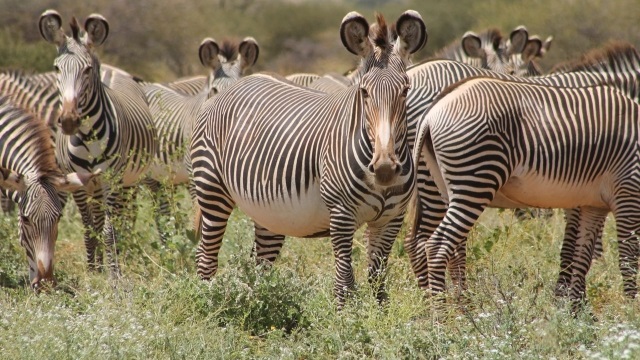
Petting Day
1 October 2018
Shortly after Porridge and Rice was founded, I was looking for fund raising ideas to enable the work of the charity. Inviting local people to visit to see my pets was just one of many ideas that was tried.
I expected a few people to vist, and hope to make between £50 and £100 so was really thrilled when the day raised just over £500. The petting days have become a regular event, held two or three times a year, and continue to be well attended raising money for the charity and spreading news of the work it does.
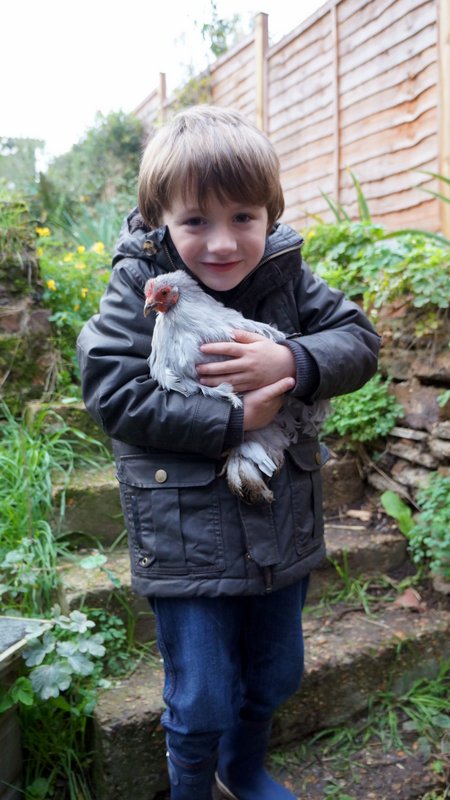

Sarah Kendall: Australian Trilogy
19 September 2018
I had never heard of Sarah Kendall before listening to Sarah kendall: Australian Trilogy. I am now a huge fan.
She is funny, insightful, and sensitive. She writes brilliantly and is a superb storyteller. She reminds me of David Sedaris, a man whose work I adore. I have listened to all three episodes several times, and will most certainly be listening again.
I hope that she continues to write and broadcast.


Primrose time
23 April 2018
My primroses never let me down.
Frankly, I don't like the modern hybrids that seem so widespread, but adore the wild primrose, primula vulgaris.
I prefer the large clusters of smaller softer flowers that covers the clump as it grows bigger each year. I love the way their bright yellow centres with pastel yellow petals fill corners of the garden like dabs of paint on a dull canvas.
I find the way they rush onto the garden scene competing with the daffodils to see who can flower first while other plants stagger slowly into spring, quite delightful. They seem to me to have personality, cheeky, lively, and eager.
Each year, I lift and split them potting up several to sell at fairs to raise money for Porridge and Rice, and each year they come back colourful and bright.
If you hadn't already guessed, I am a big fan.


Under attack
14 April 2018
Several years ago, I saw a cute little brown mouse run across the sitting room floor. It was winter and absolutely freezing outdoors, so perfectly understandable that the little fellow had ventured indoors, and I didn't mind letting him escape from the weather. The same thing happened each winter, and me being the mad animal lover, I actually looked forward each winter to seeing the minute little nose twitching nervously as it scampered across the lounge floor with its charming large round eyes.
This year, everything changed.
One morning, I took out a new box of tea from the cupboard to see that it had a hole nibbled into the box. On closer inspection, I discovered that half the food in the cupboard had been attacked by mice leaving droppings everywhere in the food cupboards. On a subsequent morning, I saw a mouse run ahead of me into the bathroom and one evening, my son opened his bedroom door and a mouse ran out. One mouse had become many and the house was infested.
My feelings changed very quickly. I went from seeing cute little rodents taking shelter in the warmth to anger and digust. I declared war with total eradication being the goal.
At first, I put down poison and even though some of it disappeared, the mice continued to attack food and turn up all around the house so after a few weeks, I decided that I had to up my game and switched to mouse traps with peanut butter as bait with great results. Rather macabrely, I took delight in the steady stream of mouse corpses each morning adding up the numbers with satisfaction. After about a week, the traps failed to fill each night, and I realised that I had won, and we had a mouse free house again.
Hopefully, news will filter out into the mouse kingdom because any mouse that ventures into my house next winter will encounter the wrath of the peanut butter loaded mouse trap.
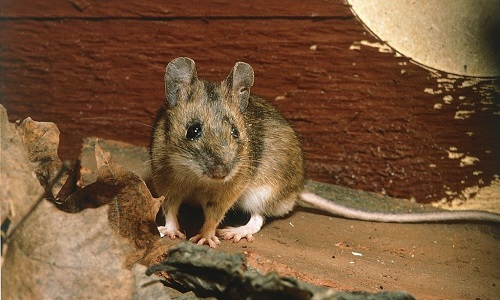

Spring has sprung
10 March 2018
The garden has begun to come to life hearalding the end of winter and the start of spring. The garden will soon be alive with new growth and inquisitive insects. Two that always make me happy each year, are the first rhubarb stems and bright crocus flowers in the lawn.


Chickens
1 March 2018
I breed Pekin Bantams, a small chicken breed known for their fluffy tails and feet, and friendly nature.
My Pekins like nothing better than to be allowed to wander freely around the garden nibbling on leaves, scratching in the flower beds, and chasing flying insects. While having fun they keep garden pests under control making it a win for them and me.